
Terry London has always had a great passion for music, especially jazz, and has amassed a collection of over 7,000 CDs covering the history of this uniquely American art form. Even in his teenage years, Terry developed a passion for auditioning different systems and components to see if they could come anywhere close to the sound of live music, and has for the last forty years had great fun and pleasure chasing this illusion in his two-channel home system.
Terry is a practitioner of Rational Emotive Behavior Therapy by day, and runs the Chicago Institute for REBT. He has also authored nine books on this of type psychotherapy and education.
 On a very cold February day in 2008, I traveled to the factory of Aether Audio located in LaPorte, Indiana, to meet the CEO/Designer Bob Smith, to audition his Reference Revelation MR-1 MK-III speaker valued at $18,900 a pair. It turned out that the night before, the furnace had broken down and it was around 30 degrees in his listening space. The pair of Revelations had just been recently constructed and were nowhere close to being broken in. Finally, the upstream electronics were far from what would be considered reference level. Yet, I was amazed that under these very adverse conditions, these reference level floor standers still produced beautiful music. It was because of that initial demo that I requested Aether Audio's Spirit-1SE for a proper review.
Additional Resources
• Read more bookshelf speakers from Home Theater Review.
• Explore AV receiver options in our AV Receiver Review section.
• See sources to pair with the Spirit-1SE in our Source Component Review section.
The Spirit-1SE reviewed here is the second generation of the company's first two-way stand-mount speakers. The price of Spirit-1SE is $3,490.00 a pair. The question was: could Mr. Smith bring the sublime performance of his very large and expensive reference speaker to a small stand-mount that would fit into most people's budgets and home theater or music listening space?
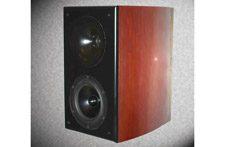
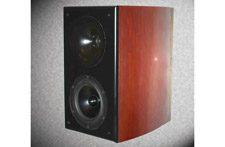
The Spirit-1SE speaker is a large two-driver stand-mount speaker with a curved-sided shape to minimize any side panel resonances while avoiding excessive weight. The dimensions are height: 17 inches, width of 10 inches front and four and a half inches back, depth of 14.6 inches. The weight of each speaker is 25 pounds.
 The Spirit-1SE packs a lot of very sophisticated technology in its design. The tweeter used is a state-of-the-art drive unit that employs a soft, fabric-type dome construction, which extends bandwidth to beyond 30kHz. Combined with the "low compression ratio" design of the waveguide at frequencies above 5kHz, it constitutes a "hybrid" form of technology that takes advantage of the best attributes of horn design while avoiding its drawbacks. The crossover is at 700Hz, which is an industry "first" in a speaker this size. In fact, it is over two octaves lower than the typical 3kHz crossover frequency commonly used in a two-way design of similar size and cost. Combined with the advantages provided by the waveguide, this allows the Spirit-1SE to perform as though it were a three-way design (woofer, midrange, tweeter), yet with far better vertical dispersion characteristics, better overall coherence and less complexity than a three-way design. Furthermore, the woofer is an aluminum cone type that offers piston-like behavior over the entire operating range to above the 700Hz crossover frequency. As such, not only does it offer deep, powerful bass performance that is uncanny for an enclosure of the Spirit-1SE's size, it also avoids the typical cone break-up and resulting midrange distortion that is common to all other paper, plastic, and other exotic material types.
The physical appearance of the Spirit-1SE is extremely attractive because of the use of real wood veneer, which is cherry maple or piano acrylic urethane material to protect the wood grain. As far as I can tell, these speakers are built to a very high standard of quality both internally and externally.
Read about the high points and the low points of the Spirit-1SE on Page 2.
 The Spirit-1SE provides one of the largest "sweet spots" of any small speaker I have experienced. Regardless of where you are or where other listeners sit, you hear a gigantic, precisely layered soundstage with each player grounded in a natural way within the stage. The Spirit-1SE is dynamic and quick, not edgy or in your face at all. The Spirit-1SE is extended on both the high and low ends. The bottom end is especially deep and taut without being constricted or dry in its tone. These speakers will do justice to the explosions of a movie soundtrack and still let the music lover enjoy a great acoustic bass fiddle.
High Points
• The Spirit-1SE offers tremendous build quality along innovative technology.
• The Spirit-1SE provides such an extended and dynamic bottom end that a subwoofer would not be necessary in many home theater situations provided they were contained within a small to medium sized room.
• The Spirit-1SE fills the listening space with a giant "sweet spot," allowing for both movies and music to be enjoyed by more listeners than other two-way monitors.
• In addition, the Spirit-1SE will do justice in a dedicated two-channel system; yet because of its punch and ability to produce at high volumes, its clarity and macro-dynamics, it fits nicely in the home theater realm too.
Low Points
• The Spirit-1SE does not come with its own dedicated stands, so the cost of high quality stands does add a bit to the Spirit-1SE's true cost.
• The Spirit-1SE is a hand-built, custom ordered speaker; therefore, there is a six to eight week waiting period upon ordering.
• Even though the Spirit-1SE is a stand-mounted speaker, its size still might be considered large in some rooms.
• Since it performs at such a high level sonically and is an easy speaker to drive, it might expose upstream component sonic weaknesses.
 Competition and Comparison
Based on price and performance, the major competitors at this high level of two-way speakers would be either the ProAc Response D Two valued at $3,500.00 or the Esoteric MG-10 which is valued at $2,800.00 - add $1,800.00 for dedicated stands. Both of these speakers are wonderful, musical and enjoyable transducers in their own right. However, neither offer the same large panoramic soundstage or the ability to produce the high volume pressure levels as the Spirit-1SE. I believe all three of the speakers mentioned would be excellent choices for two-channel music systems. If you are looking for speakers for music and home th
eater performance, then the pick would be the Spirit-1SE for the value and performance.
For more on these speakers as well as other bookshelf designs please check out Home Theater Review's Bookshelf Loudspeaker page.
Conclusion
I started with the question, "Could Bob Smith get anywhere close to the sonic performance of his floor standing reference speaker in a small, compact stand-mounted speaker?" Quite clearly, the answer is yes, for the Spirit-1SE bookshelf loudspeaker is among the finest sounding, compact loudspeakers I've ever heard. The Spirit-1SE's soundstage, imaging and bass prowess were impressive to say the least, making the Spirit-1SE among the better all-rounders when compared to other bookshelf loudspeakers. Whether your taste is music or movies, the Spirit-1SE should serve you well and provide you with years of enjoyment and high-end bliss without having to endure a high-end price.
Additional Resources
• Read more bookshelf speakers from Home Theater Review.
• Explore AV receiver options in our AV Receiver Review section.
• See sources to pair with the Spirit-1SE in our Source Component Review section.
