Andrew Robinson began his career as an art director in entertainment advertising in 2003, after graduating from Art Center College of Design. In 2006, he became a creative director at Crew Creative Advertising, and oversaw the agency's Television Division, where he worked for clients such as TNT, TBS, History, FX, and Bravo to name a few. He now has one of the most popular AV-related channels on YouTube.
 The big story at CEDIA 2011 in Indianapolis, if you happened to be a native, had to be Payton Manning's possibly career ending neck surgery, though for the rest of us the story was 4K and the emergence of "faux K." 4K, according to the standard set forth by DCI (Digital Cinema Initiative), is an image that is 4,096 pixels wide by 2,160 pixels tall. "Faux K" on the other hand is 3,840 pixels across by 2,160. The reason I bring up the two "formats" is because there was a lot of buzz surrounding 4K;however there was only one company with the goods to back up the hype - Sony.
Additional Resources
• Read more original coverage in our Feature News Stories section.
• See similar stories in our Industry Trade News section.
• Explore reviews in our Video Projector, LED HDTV, and Plasma HDTV review sections.
• Learn more in our Floorstanding Speaker, Bookshelf Speaker, and Amp review sections.
 Sony
Sony
Sony was the clear winner at CEDIA this year with the introduction of their new, consumer grade, 4K front projector, the VPL-VW1000ES. Boasting a native resolution of 4,096 x 2,160, the VPL-VW10000ES is a true 4K projector that can also scale legacy sources (DVD, broadcast and Blu-ray) to 4K via its internal scaler. The VPL-VW1000ES has a reported brightness of 2,000 ANSI lumens with a 1,000,000:1 dynamic contrast ratio. On top of being a native 4K product the VPL-VW10000ES is also a 3D capable projector, though Sony was not demonstrating its 3D prowess during the show. Sony says the VPL-VW1000ES will be available later this year, think December, and will retail for a little under $25,000 - not bad, considering the nearest 4K option not named the VPL-VW1000ES starts north of $100,000.
I sat for a demo of the VPL-VW1000ES and came away very impressed. Its upscaling prowess was brilliant and showcased nicely via a clip from Resident Evil: Afterlife on Blu-ray disc. Sony did head to head comparisons of 1080p versus 4K using still photos captured on a large format still camera and again the differences in resolution were readily apparent and far from subtle. In terms of showcasing 4K in its native form, Sony had the trailer for the new Spider Man film for our eyes to feast upon, though if I'm honest the 1080p upscaled demo of Resident Evil: Afterlife was actually more impressive for it really highlighted, at least for me, why one could benefit from owning a 4K projector now versus in the future. No word on when native 4K content will be available for home consumption, though there is a rumor swirling around CEDIA, mainly the Sony booth, that Sony is working on a new compression standard to fit 4K content onto Blu-ray discs. If this is true (and if it can be done), then 4K may be closer to becoming reality than any of us, present company included, ever thought.
JVC
JVC had a few new projectors on hand for CEDIA, two of which were being touted as 4K capable models. The DLA-RS65 and RS55 D-ILA projectors both claim to be 4K capable, though closer inspection actually revealed them to be "faux K" projectors, each possessing resolutions of 3,840 x 2,160 - not true 4K. Both the RS65 and RS55 projectors upscale legacy sources to "faux K" via JVC's e-Shift technology, which basically duplicates pixels and offsets them slightly to create a 4K-like pixel density. The RS65 will retail for a little under $12,000 whereas the RS55 will have retail price just shy of $8,000. Both projectors are 3D capable and are THX and ISF Certified.
I got up close and personal with the RS65 and found its performance to be quite good - okay, amazing - though I came away somewhat upset for once again (due to a lack of corporation among the manufacturers), we appear to have two competing standards, true DCI compliant 4K and consumer "faux K." I know why JVC has chosen to make a pit stop short of the true 4K goal - I'm just not sure it was the right move, thanks in part to another projection company named Epson.
 Epson
Epson
Epson was showcasing two new projectors at CEDIA this year, the Pro Cinema 6010 and the Pro Cinema 6100. The 6010 is a 2D/3D 1080p projector with 480Hz technology and a 200,000:1 reported contrast ratio and is the update to the hugely successful Pro Cinema 9700UB. There is also a consumer version in the form of the Home Cinema 5010. Both the Pro Cinema 6010 and the Home Cinema 5010 come with Epson's zero dead pixel guarantee, a replacement lamp, ceiling mount, cable shroud and three year limited warranty. The Pro Cinema comes with two pairs of 3D glasses and will retail for less than $4,000 while the Home Cinema 5010 ships sans 3D glasses (sold separately for under $100 each) and will retail for around $2,000 - if memory serves me.
I sat in on a demo of the Pro Cinema 6010 and came away very impressed, especially with regards to its 3D performance, which I found to be exemplary and among t
he best I've seen regardless of price. That says a lot, for I generally hate 3D and I'm not alone, for 3D was NOT a selling point or even a draw at this year's CEDIA show. For their asking prices, both the 5010 and the 6010 are the projectors to beat in their price brackets though the most impressive video demonstration of the whole show came by way of another Epson projector - the Pro Cinema 6100.
The Pro Cinema 6100 is a 2D only front projector, which will retail for less than $5,000 when it becomes available later this year. Featuring Epson's version of D-ILA, the Pro Cinema 6100 has a reported 1,000,000:1 contrast ratio with a unique anamorphic lens memory setting which basically renders the need for an anamorphic lens useless - provided you don't mind sitting through the 6100's automated zoom out and focus procedure. The Pro Cinema 6100 features a new industrial design language, which is simply stunning. In terms of its performance, the Pro Cinema 6100, projected onto a Stewart Cine-W auto-masking StudioTek 130 screen, was bite-the-back-of-your-hand brilliant in terms of its contrast, color and detail presentation. While the Sony may have had it over the Pro Cinema 6100 in terms of its overall resolution (evident in only the finest details), I believed the 6100's performance, pound-for-pound, was more impressive. The Pro Cinema 6100's lens memory feature is also a nice addition and one I wish more projectors had. I can't wait to get the Pro Cinema 6100 in for review, though if the reaction to the 6100 at Epson's booth is any indication, I may have to get in line.
 Vutec / Stewart / SI Screens
Vutec had a large portion of their booth dedicated to their ArtScreen solution, which has come a LONG way since the last time I saw it at CEDIA 2010. Now offered in a variety of wood veneers, Vutec's ArtScreen does go a long way in dressing up a front projection screen as well as your HDTV, especially when mounted on a motorized articulating mount.
Not to be outdone Stewart Filmscreen also added a number of wood veneers to their Couture Collection of screens, which unlike the Vutec veneers are wrapped around the frame of the screen itself versus outside it. Both solutions looked brilliant though Stewart's doesn't mask your screen with artwork when not in use.
SI Screens had their Zero Edge Black Diamond screens on had at CEDIA this year and to the casual viewer probably appeared more like large LED or LCD displays than front projection screens, thanks to their slim profile and barely there bezel.
Other Video Brands
Toshiba, LG and Sharp were AWOL at this year's CEDIA leaving Samsung and Panasonic to pick up the slack, though their presence seemed mostly to be for appearances only. Companies like Digital Projection were on hand though I'm not sure how relevant their current line-up of products are now that Epson, Sony and JVC have thrown down the proverbial gauntlet. Looking past a shaky economy for just a moment, how can Digital Projection hope to sell $20,000 - $40,000 1080p projectors when Sony is doing 4K for less and Epson has basically set the standard for 1080p and done so for under $5,000? A year ago, hell - six months ago - I could make a strong argument for companies like Digital Projection, but after this year's CEDIA... not so much. Sorry, but when the grand daddy of high-end video, Runco, is touting a $4,000 1080p DLP projector, it's time to jump on the budget bandwagon.
Also disappointing was the luke-warm roll out of Pioneer - I mean, Sharp's Elite 3D LED HDTV. Showcased along the back wall of Pioneer's booth, the 60-inch Elite was on full display with no one stopping to take a look-see. The Elite did look good, arguably the best among the LED displays at the show (though it's easy to be the best when your competition stays home), I'm just not sure it's worth it - I'm holding out hope until our review unit arrives.
In terms of audio there was a bit more to be excited about at this year's CEDIA over past shows - though the focus was squarely on high-performance, high-value products, lead by none other than Sandy Gross and his new speaker company GoldenEar Technology.
Read more coverage on CEDIA 2011, starting with GoldenEar on Page 2.
 GoldenEar Technology
GoldenEar used CEDIA to launch their new series of bookshelf loudspeakers, the Aon 2 and 3. Retailing for $399 and $499 each respectively, the Aon bookshelf loudspeakers were nothing short of astounding. I sat for not one but two demos featuring the Aon 3 bookshelf loudspeakers and came away speechless each time. The Aon 3's bass was impressive to say the least and its control was extraordinary. The Aon 3 sounded positively huge, casting one of the most enveloping soundstages I've heard from a bookshelf speaker and the level of detail contained within the soundstage was stunning. The best word I've managed to come up with in order to describe the Aon 3's sound is "effortless" for that's exactly what they sound like - effortless. As impressed as I was by GoldenEar's Triton Two floorstanding loudspeaker, I think the Aon 3s may be better - maybe.
Paradigm / Anthem
Paradigm's booth was hopping this year with Paradigm's Marketing Manager, Mark Aling, on the digital one's and two's showing off Paradigm's new Shift powered bookshelf speakers which start at $279 each and come in a variety of colors - à la Wilson Audio. The Shift powered monitors were impressive, so much so that I ordered a pair for my brother (who's still in college) right from the show floor. Look for a full review of Paradigm's Shift speakers early in 2012. Paradigm also had their newly redesigned Monitor Series line-up on display, which looked stunning with their soft touch, smooth front fascia and redesigned cabinetry. Prices start at super affordable and go up to still affordable if you catch my drift and are available now. I have a pair of Monitor 7 floorstanding loudspeakers in hand for review so look for that review shortly.
The big news out of Anthem this year was the announcement of their first digital amp, the M1, which packs a hell of a punch at 1,000 Watts into eight Ohms and 2,000 Watts into four. This one rack space high piece was on static display only, though it shares the same look and feel as Anthem's other Statement products. The M1 should be available soon and will carry
with it a retail price of $3,499 each.
 Focal
Focal
Focal had a nice presence at CEDIA this year anchored by the presence of their show-stopping Utopia line of loudspeakers - though the real story out of Focal had to be their Bird 2.1 system which consists of two small satellite speakers and an integrated amp, of sorts, which also doubles as the system's subwoofer. The Bird system can be configured to include three different sized satellite loudspeakers with prices starting at $999 for the whole system. For just under a grand the Bird system was stupid good and managed to fill the booth with glorious sound even when outfitted with the smallest of the satellite options. Those of you with significant others who don't understand your "sickness" would be well served auditioning the Bird system as soon as possible. Those in the market for a soundbar solution for your office or bedroom should also take note.
 Episode / Snap AV
Speaking of soundbars, newcomer Episode loudspeakers was on hand this year showcasing two passive soundbar solutions as well as a variety of on-wall speakers. The Episode 300 Series soundbars looked elegant in their smooth, high-gloss black finish and were downright affordable at $499.95 for the 30-inch and $599.95 for the 40-inch. Snap AV used the Episode 300 soundbars to showcase a new HDTV mount that mounts the compact soundbars directly to the bottom of virtually any HDTV display. Those of you who may already own a soundbar but like the idea of integrating it to your current HDTV shouldn't worry for the Snap AV mount works with most third party soundbars as well.
Krell
Krell had their products on static display alongside Sim2, though the big news out of Krell at this year's show was their introduction to the on-wall speaker category. Krell's newest on-wall, which is still undergoing final tweaks, will retail for $6,000 each and features the same driver complement and crossovers as their famous Modulari Duo floorstanding loudspeaker. The Krell on-wall loudspeaker can be customized to match virtually any décor thanks in part to Krell's partnership with Leon loudspeakers - makers of truly custom on-wall speaker solutions. While $6,000 each may sound steep it's positively affordable compared to ...
Wisdom Audio
Wisdom Audio brought both their LS4 and LS3 on-wall loudspeakers to CEDIA this year. While the duo may have been on static display on the show floor, their presence still managed to stop traffic. Also on display was a new prototype design of Wisdom's upcoming Insight Series, which looks to be more of an introductory series below their now famous Sage Series. The Insight Series features an all-new planar magnetic driver system as well as new dynamic woofers that help give it a far more streamlined look compared to the Sage Series. The Insight Series also has a virtually non-existent bezel around the edges ensuring a nearly invisible final installation. No word on pricing or availability.
Wharfedale
Wharfedale had their new Jade Series floorstanding loudspeakers on display at CEDIA this year, spinning vinyl of all things from the middle of the show floor. In conditions that would scare other speaker companies, the Jade Series loudspeakers sounded fantastic and managed to be captivating despite all the distraction and noise going on around. What was even more captivating about the Jade Series speakers was how utterly affordable they were with the largest of the floorstanding models topping out at $4,200 a pair. You better believe we'll be reviewing them soon.
 Audio Research
In terms of electronics Audio Research had their new line of digital amps on display as well as a newly redesigned Reference Series of products. Audio Research's digital amps range in power from 225-Watts to 450-Watts mono. On the Reference Side of things Audio Research was also showing off their new Reference 250 tube monaural amplifier.
Integra
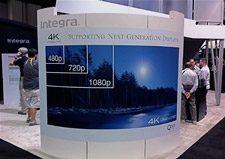
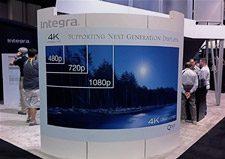
The big story out of Integra was the debut of their "faux K" upscaling technology, which can be found in many of their new receivers, AV processors and Blu-ray players. Like JVC, Integra's 4K isn't quite true 4K, stopping short of 4,000 pixels with 3,840; though the results were still impressive, especially on legacy formats such as DVD.
NAD / PSB
PSB used CEDIA to announce their foray into the headphone market with their new M4U 2 headphones. Retailing for $400 the M4U 2s were comfortable and lightweight and sounded good on the show floor effectively blocking out all ambient noise leaving nothing but music in their wake.
NAD had a host of new products on display at CEDIA this year beginning with their VISO 1 music system, which is a lifestyle oriented product aimed at the iPod enthusiast. The iPod/iPhone dock/ integrated speaker system had a terrific form factor though it was upstaged by its sound, which was surprisingly good given its design and chosen source component. The VISO 1 will retail for $700 and should be available soon.
Also from NAD was the unveiling of their M51 Direct Digital DAC/ digital preamp for $2,000. The M51 was on static display at the NAD booth but possessed enough "wow" factor on paper that I had to request it for review for it looks to be the ideal centerpiece for anyone looking to build a music first, all-digital, two channel audio/ home theater system, which surprisingly enough is a concept that is growing in popularity. The M51 has two HDMI inputs and a single HDMI out along all three digital audio inputs, optical, coaxial and AES/EBU as well as a single USB input. The M51 also features both balanced and unbalanced audio outs as well as full RS-232 support. Look for a review of the M51 as well as other NAD reviews in the New Year from Home Theater Review.
 BDI
BDI
BDI had two new lifestyle oriented equipment racks on display at CEDIA this year, the OLA and NORA home theater cabinets. The OLA cabinet was on display in both of its finishes, gloss white and chocolate stained walnut, both looking rather striking, accented nicely by the OLA's flowing profile. The NORA cabinet is more "square" than the OLA though equally stunning in white or its soft-touch black that works wonders in hiding unsightly fingerprints. Seriously, after a full day at the show there wasn't a mark to be found anywhere atop the NORA's cabinet - call the folks at CSI, they won't find anything.
Sanus
Sanus was showing off their newly updated, custom install friendly, AV equipment racks, which are fantastic for they include ever
ything you need (shelves, blanking plates, screws etc) to create a custom looking rack installation without spending custom install-like money. Their largest AV equipment rack retails for a little more than $1,000 which may sound like a lot until you consider it's about a third as much as you'll spend with the competition. As cool as Sanus' AV racks were (and they were, hell - I ordered one), the big news at the Sanus booth was their free iPhone and iPad App aimed at helping you in your HDTV mount purchase and installation. Seriously, this free App is sweet, for all you have to do is enter your HDTVs model number and the App pulls up a list of compatible mounts for you to choose from. Once you've chosen and purchased your desired mount it will tell you how and where to mount it on your wall based on how high you want it to sit off the floor as well as help you level the sucker, for the App has a built-in digital leveler too. Download this App now if for no other reason than to play with it while your boss is droning on about sales figures and quarterly reports.
Additional Resources
• Read more original coverage in our Feature News Stories section.
• See similar stories in our Industry Trade News section.
• Explore reviews in our Video Projector, LED HDTV, and Plasma HDTV review sections.
• Learn more in our Floorstanding Speaker, Bookshelf Speaker, and Amp review sections.