

Name a pursuit or hobby. Better still, think of your own prime passion. Think of the ultimate fantasy which relates to it. Cars? You probably fantasise about owning a Diablo and a place to drive it. Boating? You want a yacht. Food? A line of credit and a permanent table at Gundel. Champagne? A cellar full of Krug. And so it goes for all of us mere mortals who cannot afford to indulge in the ultimate extensions of our main type of pleasure. And, in the context of home theatre, you'd imagine that a videophile's Holy Grail would be to own a real cinema.
Additional Resources
• Read more reviews of video projectors on HomeTheaterReview.com.
• See more floorstanding reviews.
• Explore our Amplifier Review section.
I've just sampled the next best thing, nearly as costly but infinitely more practical than a 1500-seater needing a steady supply of 35mm films, staff and a heating bill running to five figures per annum. Think of the closest approximation of a cinema in the home and you've nailed it on the head. Think Cello and you've named it, too.
Most of us with videophile tendencies make do with cost-effective add-ons which combine to convert our 'normal' hi-fi, 'normal' VCR and 'normal' TV monitor into a surround-sound set-up. We do not believe for a moment that it's a substitute for a session at the Rialto (even if the actual sound quality is better), but it sure beats the hell out of the mono wheezes which always made TV viewing a compromise. After a time, we might graduate to larger screens, better hi-fi systems, more sophisticated processors, laser disc instead of tape. And we are happy with our viewing facilities so that we can return to them after seeing a film in the cinema without too much disappointment. That's because we tell ourselves that viewing in the home is not the same as sitting in front of a screen of billboard proportions. We adjust accordingly.
But Cello's Mark Levinson thinks big -- always has, always will. He doesn't understand the concept of 'limitations'. Whatever his rivals may think, whatever future hi-fi historians may write, the fact remains that Levinson, some 20 years ago, took hi-fi out of the Mickey Mouse league and plunked it straight into the luxo-class. He created the concept of cost-no-object design. For this, he was reviled by the right-on anti-materialists; at the same time, he enabled all other hi-fi manufacturers to move their goal posts by a few kilometres. The 1970s/1980s saw hi-fi reach levels of performance inconceivable in the 1960s. Now he wants to do the same for video.
Maybe Levinson feels that home theatre has now reached a level of maturity which will allow for the creation of a true video high end. Maybe he's acknowledged that hi-fi is moribund and its future depends on links with video. More likely, his motivation may be just his love for films, an enthusiasm almost as great as his love for music. A cynic might even argue that he's simply clever enough to see a sound commercial opportunity. Frankly, I don't care what moved Levinson. Rather, I appreciate that he's the first seasoned high end manufacturer to apply the same values to visuals that we have grown to accept as the standards for audio.
This lengthy preamble is necessary to prevent grunts of dismay similar to those which greeted the first big bucks hi-fi systems. The price of the top Cello video system is so far beyond anything currently on offer that the words 'leap' and 'quantum' come to mind. Levinson is not an apologist, nor should he (or any other manufacturer of luxury goods) become one. He is the first to acknowledge that Cello products are not 'affordable' in any conventional sense of the word. Indeed, your typical customer for the full-blown Cello Music and Film System will be a millionaire. He or she will have at least one spare room to serve as a dedicated home theatre. He or she will be either connected to the movie/video industry, using the home theatre system for business and pleasure, or an obsessive, wealthy, movie-loving civilian.
What I saw is the very latest version of the system first given a major public airing at last year's Summer CES. I had to fly to Hong Kong to see it (it's a tough life) because as of late 1992 only one full set-up had been produced; at the time, the two Cello showrooms in the US had earlier versions on display. Much of it will be familiar to those who have followed Cello's audio activities.
The sonics are handled by the well-known Audio Suite pre-amplifier, the Audio Palette equalisation system and the Performance amplifiers, driving a pair of the Strad Grand Master loudspeakers. This, of course, is dreamware, the kind of equipment which fights for the title of state-of-the-art alongside other high end products. But the items which concern us here, the items which point to a revolution in home entertainment, are all-new, leading edge and --as far as I can ascertain -- without any serious rivals.
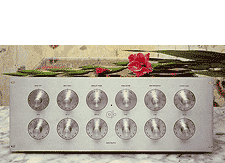
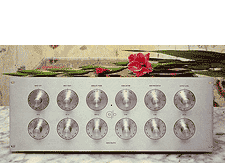
The link between the music and the film portions of the Cello system is the D/A converter which accepts the laser disc player's audio output. As with everything on the video side of the Cello package, the DAC is the product of a collaboration, Cello joining with Apogee Electronics Corp of California (not the ribbon speaker builder but a name known in professional circles for studio quality hardware). Apogee has produced special versions of its Series 8 D/A and A/D converters for the Cello system, the units incorporating Cello-specified analogue circuitry, Swiss-made 3-pin Fisher connectors and a new front panel.
Read more about the performance of this system on Page 2.
Cello already had a strong presence in professional audio, and a
number of the company's clients -- including Bob Ludwig and Ted Jensen
-- were using Apogee's DA-1000E and AD-500 converters in their studios.
What sold Levinson is the new anti-jitter circuitry based around a
low-jitter clock, with better than 30 picosecond rejection and said to
allow coaxial and TOSlink connectors to outperform AT&T glass
connections. Additionally, Levinson thinks it's so good that it negates
the differences in transports. (The inclusion of TOSlink was deemed
crucial as the majority of today's laser disc players feature TOS
connectors for digital audio output.) The jitter clock was designed by
Bruce Jackson, sound manager for Bruce Springsteen among others, and
also the designer of highly-coveted retro-fit boards for the Sony 1610.
Unlike most domestic audio DACs, the Apogee eschews chips by offering
programmable geometry and proprietary software.
So what to use for a transport? Especially as the Apogee is supposed
to be a great leveller? Cello settled on the Pioneer CLD95, which
Levinson describes as producing 'the best picture I've ever seen'. And
it's likely that there will be a Cello-badged version, tweaked by Cello
and providing revised cosmetics. It's a handsome beast, capable of
playing laser and audio discs and selling for around $2000 -- which
makes it the least expensive part of the system.
Now we come to the most impressive unit in the system, the Cello
Video Palette. Built by Faroudja Laboratories in California, it employs
Faroudja's advanced video technology for line doubling, scan
conversion, decoding and bandwidth expansion. The Cello version is
similar to Faroudja's broadcast-standard LD100, but made domestically
acceptable with a whisper fan and a front panel to match other Cello
components. Inputs include Composite In (75 ohm), S Video and RBG,
while the output is RGB to the projector. The video decoding converts
NTSC In to RGB Out, the Faroudja 'thinking' in RGB. Signal processing
includes the aforementioned duties plus motion correction, while
individual front-panel controls handle brightness, contrast, colour,
tint and detail. And demonstrating it is far easier than impressing an
audience with subtle sonic tweaking.
Without telling me which switches he was flicking, Levinson ran
through the Palette's capabilities, the most obvious (and necessary)
being the line doubling. Without it, the picture on the 8x6ft screen
(Cello recommends a Stewart at around $2000) looked just like blown-up
TV: annoying, coarse lines turning the image into corduroy. Switch on
the doubler and it was suddenly silk, near enough to 35mm to leave you
gasping. The controls were easy to use; as with the Audio Palette, five
minutes' worth of hands-on experience is all you need. What it does is
improve focus and image stability, create realistic colour, reduce
smearing, provide blacker blacks and whiter whites and reduce
'burn-outs'. Most impressive of all, the system delivers the kind of
image depth tha'ts virtually 3D without the goggles, a standard virtue
of cinema viewing which has eluded home theatre and which makes the
experience so much more convincing. The effects are not subtle at all,
even to my aging eyes.
To project this cleaned-up image, Cello has collaborated with Ampro,
a Florida-based company which makes industrial projectors such as would
be used by major companies for presentations, exhibitions and the like.
The top of the line model is the reason I had to travel half way 'round
the world; Hong Kong received the first sample of Cello's VRP 890M.
Based on Ampro's 4200 high-resolution industrial projector, it employs
9in, magnetic focus tubes, graphics-grade high-definition lenses, a
digital chassis and an ultra-quiet fan cooling system based on Cello
designs. The projector has memory to store up to 50 aspect ratios,
essential now that the software companies such as Tartan are issuing
tapes and discs using the films' original aspect ratios, and both
hard-wired and infra-red remote control operation allow adjustment from
the viewing position.
The VRP 890M differs from the less-expensive VRP 890E only in that
it offers magnetic rather than electrostatic focus operation, magnetic
delivering a 15-20% improvement in resolution. The 9in tubes provide
more brightness than do 7in tubes, typically 1100 lumens vs 700 lumens.
The bandwidth is 75mHz, better than double that of most domestic
projectors, while the scan rate is 85kHz, comparable to a typical 55kHz
for domestic offerings. The specifications are said to better the
minimum needed for HDTV by 'probably 50%'.
Other facilities include vertical and horizontal blanking (useful
when you see microphones hanging from ceilings in movies broadcast with
the wrong aspect ratio), compression and expansion which allow the
projector to be used a variety of video sources, open architecture to
accept mods for future formats and more. One musing involved the
playing of computer games through the system, which should prove
interesting as the Ampro was designed first and foremost as a computer
graphics projector. Tube life should run between 10,000-20,000 hours,
which means that -- at $45,000 for the projector -- you're looking at
$2-plus per hour viewing should you trash it instead of replacing the
tubes...
And just in case you have a lot of friends, the '890M can fill a screen up to 30ft wide.
Add the $45,000 for the projector to $2000 for the screen, $5500 for
the DAC-plus-power supply (and another $4500 for A/D conversion),
$18,000 for the Video Palette and you have around $70,000 not counting
the audio system or transport. I reckon $200,000 all-in should cover
the works, including a bit of carpentry and a few comfy Eames chairs
plus hassocks. Is this what it takes to become your own J Arthur Rank?
Since most of you know me only as an audiophile, let me set the
standards which I use...cinema-wise. I can name every main role played
by Frank Thring and know the difference between Laird Cregar and Lon
Chaney Jr. I know who played the zither for The Third Man theme and
what Valentino drove. I've seen The Producers 50 times and can tell you
what camera James Stewart used in Rear Window. In other words, I lurve
the movies -- enough to have see Plan 9 From Outer Space when I was
seven...30 years before it became hip. So, putting on my Barry Norman
jumper, I let Levinson do his stuff.
He started out so conventionally that I wanted to hop back on the
plane. Terminator 2 is to 1993 what Top Gun was to 1991, demo'd to
death. But what I was seeing seemed like a new film. The detail, the
sound of the crashes (the truck chase scene -- what else?) the fluidity
of the transformations, the clarity of the explosions, the sense of
speed while racing through the L.A. 'canals'. I was hooked.
We moved onto a personal favourite, that affectionate pulp hommage,
The Rocketeer. Those flying sequences -- it reminded me of my lone
visit to a true Cinerama theatre as a child. Full field of vision, side
to side and top to bottom. Vivid colours. A flood of sound. Amusingly,
the Lexicon surround sound decoder hadn't been installed by the time of
my arival, but I never missed the centre or rear channels. And I had to
keep telling myself that I was in a medium-sized listening room in a
hi-fi shop.
Onto Fried Green Tomatoes, the kind of film which normally makes me
gag. I told Mark what I thought of low-key, 'quality' movies adored by
the critics. He said, 'Just watch', issuing the same kind of invitation
which people swear will get me 'into' classical music if only I heard
the right stuff on the right system. Well, it never worked for me with
music, so why should a killer film system make me enjoy a movie on a
par with an episode from The Waltons?
Okay, so I did laugh at the food fight, the car park incident. And
yes, the system did increase the involvement, maybe because it's not
like watching broadcast TV, when you can flip quickly to another
channel. I was reminded of my own lack of immunity to this century's
decimating of our attention spans. I was aware that I hadn't fully
resisted the mind-compression employed by modern media. I sat there as
if I'd paid real money at the kiosk out front. All that was missing was
a huge tub of salted and buttered, a tube of Rolos and a shoulder to
encircle.
I should tell you that I was sitting in a room empty of all but the
hi-fi equipment and a couple of directors' chairs. Lights on, and it
looked like a chic warehouse, with nothing to suggest picture palaces,
Hollywood or making out in the balcony. Lights off, and all that was
missing was an usher with a torch.
But let's get real. Even if you specify lesser hi-fi equipment --
which Levinson says in stupid because the secret to convincing cinema
is unassailable dynamic capabilities -- you're talking six figures. And
although there are less-expensive projectors and even a back-projection
set in the Cello range, the Video Palette is still a serious
investment. And I can't speak for the lesser models. But, and I hate to
say this, I've seen the standard by which all home theatre systems must
be measured.
And, no, I'm no longer happy with an eight-year-old 22-incher.
Additional Resources
• Read more reviews of video projectors on HomeTheaterReview.com.
• See more floorstanding reviews.
• Explore our Amplifier Review section.
