• AddThis Social Bookmark Button

Copland CDA 266 Compact Disc Player reviewed


  • January 11, 2009

| Print Page | Adjust Font Size:

Free Home Theater Review Weekly Newsletter.

Enter your e-mail below to get Home Theater Review's weekly newsletter with the latest equipment reviews and home theater news sent directly to your inbox.


*Required

Had I paid attention in Psychology 101, this review could have featured a mini dissertation on the single-chassis vs two-box debate. To separate or not to separate - that is the question. It's just that any single-box CD player over £1000 has to compete not just with other single-piece designs, but with entry-level transport/DAC combinations as well. And the Copland CDA 266 is imported into the UK by the same source which handles the awesome Theta Chroma converter...

Not to worry: I'm convinced that there are numerous consumers who don't want to accommodate an extra box, sacrifice an extra mains outlet, invest in a digital cable or whatever else it takes to go two-way. The reasons to prefer a single-box design over separates are just as compelling as those in favour of splitting a player into two, so let's just agree, for the sake of argument, to regard the Copland on its own terms. If you're pre-disposed toward separates, you probably wouldn't have read this far anyway. But if you're looking for one honey of a single box player, read on.

The CDA 266 is Copland's the third and final CD player in a trilogy which also includes the CDA 277 (£1,799) and CDA 288 (£2,199). This one's the entry-level model at £1,199 and it's ideally suited to match one of Copland's integrated amplifiers in both price and aesthetics. Though the CDA 266 shares certain family traits with the CDA 288 and CDA 277, a number of dissimilarities mean that various prejudices against the dearer models - especially the controversial '288 - should be ignored. This is an altogether different beastie, which shouldn't suffer because its siblings were, uh, delinquents.

High value for money rears its blessed head in that the Copland has the look, feel and calibre of internal ingredients of players selling for a far higher four figures, like those with a '3' at the front. Whatever one thinks of HDCD, plenty of people regard the Pacific Microsonics PMD100 x8 oversampling digital filter as one of the best sounding on the market; even if you never purchase a single HDCD disc, you should benefit from filter's presence in the '266. To complete the processing combination are a pair of the equally revered Burr-Brown PCM 63P 20-Bit Colinear Converters and a custom-designed crystal clock oscillator 'for a more natural musical performance', i.e. lower jitter.

The analogue section features complementary Class 'A' topology using discrete components, while the power supply transformer is screened for both static and magnetism. A filter conditions the mains supply, and the power supply feeds seven separate secondaries for the various analogue and digital stages and the drive mechanism. Build quality inside mirrors the exterior - it's superb. The circuitry is divided over three main boards with a smaller PCB for the readout display, all the boards using 70mm copper tracks. The first PCB incorporates the power supplies for the digital and analogue circuits, the second contains the control system and the third deals with the signal processing. 1% metal film resistors are used throughout.

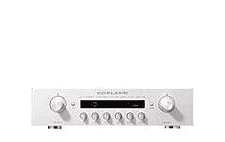
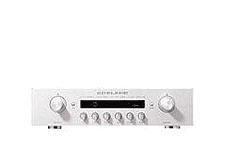
Unlike so many players suffering with Philips mechanisms, the Copland represents the new wave which looks further afield. This baby sports a smooth-acting Sony mechanism with integral four-point sprung isolation system mounted on silicon rubber bushes, and it oozes luxury - just like the player itself. Despite compact dimensions of only 430x125x375mm (WxHxD), the Copland suggests 'high end'. OK, so it bears an eerie resemblance to an exclusive, elitist American brand named after a stringed instrument, but that's only part of the reason the '266 suggests extravagance. The unit exudes solidity, thanks to a weight of 9kg, a heavy gauge, interlocking 'U'-shaped steel chassis, which also provides screening, and the presence of an alloy front panel which is a substantial 5mm thick. The latter also damps vibrations, as do the large isolation feet. And those knobs...

Ahem - this isn't , thank Christ, so lets make this clear: the use of the word has nothing to do with the mammarial vernacular. The CDA 266's knobs - hooray! A break from buttons!!! -- allow for the operation of play/pause with a simple press on the right-hand rotary, while the left-hand control provides power on/off. A combination of rotating and pushing (however salacious that sounds) accesses tracks one at a time or in rapid succession. A separate button operates open/close, and a green LED tell-tale indicates the presence of an HDCD disc. Copland's RC 288 Remote Control is a 20-function, 99-track direct-access hand-held commander in charge of a 20 track memory and all of the minor operations not handled by the front-panel rotaries. In addition to all of the expected transport and programming functions, it also provides on/off switching of the display, with two levels of illumination.

Around the back, the CDA 266 wears only an IEC mains input, a pair of substantial gold-plated phono sockets for analogue output, and a single coaxial digital output with an on/off toggle switch right next to it. Despite my bleating about single- vs two-box players, I'd love to see this offered as a stand-alone transport, just because it's such a joy to use and there's a need for a classy sub-£1000 spinner-sans-DAC. If Copland could sell it less the converter section for, say, £699, there's be queues at every dealership.

But that's wishful thinking and it has nothing to do with the '266 as a single-box player. I hooked it up to systems including the Roksan Caspian amp driving Quad 77-10L speakers, the GRAAF WFB Two and 50/50 amplification feeding Quad ESL63s and the NVA Personal amp with Tandy LX5 Pro speakers. Interconnects included Shinpy Black Hole, Nirvana and Discovery, the latter being used the most. No other goofy tweaks were employed, other than the use of XLO AC cable.

Copland's smallest CD caused something of a double-take, given its origins with a company best known for valve and valve-hybrid amplifiers. I expected a unit tailored and tuned to sound like a tube-carrying device, yet the '266 betrayed little or no obvious legerdemain in the 'voicing' department. Instead, it was polite and refined without being so lean and hygienic as to set one's teeth on edge. It's that walk along a tightrope which all concerned CD player manufacturers face, the act of addressing both subjective concerns which favour pure analogue, and the exploiting of CD's intrinsic qualities, such as scary background silences. So far, the best balancing act I've heard in a single-chassis player is Krell's new KAV-300cd; the Copland - while not a substitute nor rival for that £3499 machine - emulates it with a skill equally devoid of cynicism.

As various players have shown, it's easy enough for a canny designer to feed in the requisite distortions or colorations which pander to the tastes of analogue die-hards. And, hey, I keep nursing an elderly CAL Tempest II just because I love the almost squidgy, cuddly, mushy softness it applies to the generally brittle sound of CD. But far more challenging is the discipline which tries to make the most out of CD, treating it not as a substitute for the LP but as the first domestically viable, currently dominant digital medium. A decade-and-a-half after its launch and we're still learning how to make it work. We've come a long way from the time when a famed turntable manufacturer could say in print that helping to make digital better would be to '...help spread a nasty disease'. What Copland must have decided, after releasing the blatantly 'analogue-ish' CDA 288, is that too much pandering to the retro set is to do a disservice.

It was imperative, then, that the CDs I auditioned ran the gamut from archive material which has been through the latest 're-conditioning' (the Jimi Hendrix re-masters, the Sony-fied version of the Stooges' and the best of the JVC XRCD jazz reissues) and clean, intelligently produced, truly , post-CD era recordings (James Taylor's , Marshall Crenshaw's , a couple of Sheryl Crows and various 'unplugged' titles). The Copland promises nor delivers miracles, and those expecting the Western Electric 300B version of the truth had better look elsewhere.

What emerged from system to system, consistently and dependably, was - like Baby Bear's porridge - 'just right'. The soundstage was blissfully three-dimensional without causing frissons of agoraphobia. The image height was perceptible without making the listener feel either a giant or a dwarf. Bass? Extended, controlled and rich, but never overwhelming, tubby nor aggressive. The midband was clear, uncoloured and deliciously precise and controlled, as if the LS3/5A had suddenly turned into a CD player. Amusingly, the Copland also exhibited that speaker's famous penchant for projecting sounds slightly in front of the speaker 'line', without exactly dumping them in the listener's lap.

But it was the treble which sold me on the small Copland. Sweet, fast and extended, crisp enough to complement a rapid transient, detailed enough to ensure that every ambient clue ensured that no listener would feel for even a moment that there was any loss of information. But, again, it was so polite and well-behaved that it could lead to a different kind of malaise.

Instead of the artifice - however appealing and 'more-ish' - of a tube-based CD player, the Copland errs on the side of decency. Even when asked to expose the base behaviour of Iggy and Co, it never lost its grip, never sounded too raucous, never acted as if it was about to implode. And for an Iggy fan or a Crue member or some sad, pathetic decibel junkie, this may be asking too much. Like wearing a jacket and tie at a rave.

But this is one of the oddest times ever in hi-fi's history. We have the digitoids at one extreme, the SET worshippers at the other, a gap which couldn't be spanned by the Golden Gate Bridge. So I, for one, am glad to welcome the Copland as the voice of reason. Maybe it's old age telling me this, but the appeal of a centrist policy is so-o-o inviting. Must be a Scandinavian thing, but the Copland CDA 266 is the most diplomatic CD player I can imagine using.

Keywords

Copland CDA 266 Compact Disc Player reviewed

Subscribe to the Newsletter
Subscribe to HomeTheaterReview.com's Weekly Newsletter to get the latest news, reviews and insight on the world of home theater, HDTV and audiophile equipment. Subscription is 100% FREE!
*Required
Email Marketing by VerticalResponse
subscribe to rss Subscribe with RSS
Follow home theater equipment reviews and daily news via our RSS feed.
Related Source Component Reviews (Classic):
  • Comment on this article

    0
Post a Comment

Please answer the following question (required) before posting to help us prevent Spam.


Featured Audio-Video News

Experiencing Your Dream Home Theater While On Vacation

Experiencing Your Dream Home Theater While On Vacation -

It isn't any news that the economy is in the dumps. Morphing your living room, garage or basement into the...

Latest Source Component Reviews (Classic)

Theta Chroma Digital to Analog Converter Reviewed -

Given that Theta's sublime Pro Gen V is a device which consistently astounds me with its transparency, speed, coherence and freedom from digitalia, there should be no surprise that it's my reference converter. Much as I adore the Marantz DA-12... Click for more...

Meracus Imago CD Transport Reviewed -

No, I don't know what 'Meracus' means, and I stopped playing around with anagrams after I reached 'ear scum'. How about 'US Cream'? No way: Meracus is so decidedly, unabashedly a German company that it couldn't possibly apply. Oh, is... Click for more...

Marantz CD-63II K.I. Signature CD Player Reviewed -

On the surface, it's just another set of modifications, right? Another way to sell CD-63s, eh? I suppose that a cynic could look at it that way, but - after hearing the 'K.I. Signature' - the cynic would have to... Click for more...

Bow Technologies ZZ-Eight CD Player Reviewed -

It could have grown out of the ZZ-One integrated amp, a Siamese twin just itching to use its amplifying sibling as a plinth. Whether or not it should be 'stacked' is doubtful, given the ventilating properties of the ZZ-One's end... Click for more...

YBA CD3a Player Reviewed -

Blame the end of the Millennium, the coming of DVD, the arrivals of HDCD/20-bit remastering/XRCD, what-have-you. All I know is that we're experiencing a flood of deliberately off-the-wall CD players, and if this is anti-digital backlash, then it's over a... Click for more...

Wilson Bensch Circle Turntable Reviewed -

No puns about 'squaring the circle', 'Will the Circle Be Unbroken?', 'circle jerks' or any of that stuff: the most-obviously named turntable since the Revolver is exactly the dream Wilson Benesch watchers hoped it would be. Its shape, its simplicity,... Click for more...

Theta Pro Gen V-A Digital to Analog Converter Reviewed -

Not keeping tabs on other reviewers, I can't say if it's normal practice to use as a reference something which members of the public cannot purchase. Hot-rodded hardware, prototypes which never made it into production - there are plenty of... Click for more...

Rega Planet Turntable Reviewed -

Buying into certain 'schools' of audio thought requires the same kind of metaphorical lobotomy as becoming a slavish football supporter or joining a religious cult. In real terms - if you let the mind-set supplant part of your personality -... Click for more...

Quasar LE Turntable Reviewed -

'Gorgeous.' That's the word I kept hearing, every time someone noticed the Quasar LE turntable in for review. And one of the first to utter it was the owner of a Michell Orbe, itself no canine. What these individuals cooed... Click for more...

Linn LP12 Turntable Reviewed -

Military manoeuvres come no more complicated. Merely considering a 'top secret' review involving a panel of seven or so listeners is to court disaster, as 'secrets' and 'journalists' are mutually incompatible. But we knew, as the only British hi-fi magazine... Click for more...

Latest Source Component Reviews (Classic)

Theta Chroma Digital to Analog Converter Reviewed -

Given that Theta's sublime Pro Gen V is a device which consistently astounds me with its transparency, speed, coherence and freedom from digitalia, there should be no surprise that it's my reference converter. Much as I adore the Marantz DA-12... Click for more...

Meracus Imago CD Transport Reviewed -

No, I don't know what 'Meracus' means, and I stopped playing around with anagrams after I reached 'ear scum'. How about 'US Cream'? No way: Meracus is so decidedly, unabashedly a German company that it couldn't possibly apply. Oh, is... Click for more...

Marantz CD-63II K.I. Signature CD Player Reviewed -

On the surface, it's just another set of modifications, right? Another way to sell CD-63s, eh? I suppose that a cynic could look at it that way, but - after hearing the 'K.I. Signature' - the cynic would have to... Click for more...

Bow Technologies ZZ-Eight CD Player Reviewed -

It could have grown out of the ZZ-One integrated amp, a Siamese twin just itching to use its amplifying sibling as a plinth. Whether or not it should be 'stacked' is doubtful, given the ventilating properties of the ZZ-One's end... Click for more...

YBA CD3a Player Reviewed -

Blame the end of the Millennium, the coming of DVD, the arrivals of HDCD/20-bit remastering/XRCD, what-have-you. All I know is that we're experiencing a flood of deliberately off-the-wall CD players, and if this is anti-digital backlash, then it's over a... Click for more...

Wilson Bensch Circle Turntable Reviewed -

No puns about 'squaring the circle', 'Will the Circle Be Unbroken?', 'circle jerks' or any of that stuff: the most-obviously named turntable since the Revolver is exactly the dream Wilson Benesch watchers hoped it would be. Its shape, its simplicity,... Click for more...

Theta Pro Gen V-A Digital to Analog Converter Reviewed -

Not keeping tabs on other reviewers, I can't say if it's normal practice to use as a reference something which members of the public cannot purchase. Hot-rodded hardware, prototypes which never made it into production - there are plenty of... Click for more...

Rega Planet Turntable Reviewed -

Buying into certain 'schools' of audio thought requires the same kind of metaphorical lobotomy as becoming a slavish football supporter or joining a religious cult. In real terms - if you let the mind-set supplant part of your personality -... Click for more...

Quasar LE Turntable Reviewed -

'Gorgeous.' That's the word I kept hearing, every time someone noticed the Quasar LE turntable in for review. And one of the first to utter it was the owner of a Michell Orbe, itself no canine. What these individuals cooed... Click for more...

Linn LP12 Turntable Reviewed -

Military manoeuvres come no more complicated. Merely considering a 'top secret' review involving a panel of seven or so listeners is to court disaster, as 'secrets' and 'journalists' are mutually incompatible. But we knew, as the only British hi-fi magazine... Click for more...

All Source Component Reviews (Classic)

Latest Equipment Reviews

Mapleshade Time-Correcting Maple Bedrock Speaker Stands Reviewed -

For ages the adage with bookshelf and/or monitor speakers has always been getting the tweeter or tweeter/midrange as close to ear height will yield the best results. Of course proper placement in a room as well as in relation to... Click for more...

Mapleshade Samson V.1 Equipment Rack Reviewed -

Seemingly everyone makes an equipment rack of some form or another these days with varying degrees of success, however for best results you're better off going with a third party or specialty equipment rack. The problem with going with an... Click for more...

Oppo BDP-83 Special Edition Universal Player Reviewed -

Oppo Digital's first Blu-ray player the BDP-83 entered the market in mid 2009 to numerous accolades. A mere half year later, Oppo Digital, not satisfied with the untapped performance potential of the player, released the BDP-83 Special Edition reviewed here.... Click for more...

Parker Audio 95MK II Loudspeakers Reviewed -

Chances are you've never heard of or seen a pair of Parker Audio 95MK II loudspeakers. Because of that fact, you're probably thinking they're some sort of uber-esoteric, high-end, ultra-expensive loudspeakers from some designer's garage in Munich. Well, you'd be... Click for more...

Bel Canto e. One S300iu Integrated Amplifier Reviewed -

Integrated amplifiers have always been an effective and affordable way to get into two-channel audio. However, in recent years, integrated amplifiers have come into their own, offering performance and simplicity that even high-end separate systems have trouble matching. Case in... Click for more...

Bel Canto e.One S300 Power Amplifier Reviewed -

Stereo amplifiers have been a staple since music went from single speakers to two-way back in the day. Over the years, we've seen stereo amplifiers go from simple, manageable black boxes to over-the-top, larger-than-thou space heaters for the home and... Click for more...

OmniMount Link Series A/V Stands Reviewed -

As its name suggests, OmniMount's Link Series is a modular line of A/V stands that you can mix and match to craft the exact entertainment solution you need. You can also add on as your system grows. The Link Series,... Click for more...

Paradigm Reference Studio 20 v.5 Bookshelf Speaker Reviewed -

I've been a fan of Paradigm for years, owning and enjoying seemingly every speaker in their product line from the awesome and affordable Atoms to their flagship Signature S8s. Over the years there have been two Paradigm speaker designs that... Click for more...

Bel Canto REF 1000M Mono Amplifier Reviewed -

When one thinks of a 500-Watt mono amplifier you probably picture a large, heat sink clad hunk of steel that weighs more than the car you drove it home in and probably costs more too. What if I told you... Click for more...

OmniMount VideoBasics TV Mounts Reviewed -

You've spent the extra money to buy an ultra-thin HDTV. The last thing you want to do is hinder the minimalist look by mating the TV with a bulky wall-mount. OmniMount designed the VideoBasics line of flat-panel TV mounts with... Click for more...

Read All Reviews