

Just when you think you can consign something to the 'dustbin of history', along comes another cause for a re-think. Wiser heads than mine assure me that purist audiophiles will continue to buy conventional, two-channel CD players for decades, just as they continue to spin vinyl even unto CD's 20th anniversary. And yet, my logical side says, in the dawning of the age of SACD and DVD-A: why buy a CD player for £1598, when that will pay for a good universal player? But I hadn't reckoned on the sheer sweetness of the latest from Copland.
Copland's history as a manufacturer of CD players is slightly patchy, memory telling me that one or two machines issued by this Danish company deserved entry to Crufts. Be that as it may, Copland has gone through a period of complete rejuvenation, its entire range overhauled, a range which, yes, even addresses multi-channel. So maybe Copland is no different than the rest of you, circling in wait-and-see mode. While we pass time as the dust settles (and I am firmly of the camp which believes that every player sold a few years hence
Additional Resources
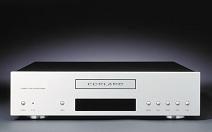
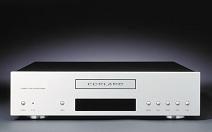
Being of Northern European origin, Copland believes in clean front panels and a less-is-more approach. Thus, some of you will fall in love with the CDA822 just because of its minimalism. There's not a whole helluva lot more that they could have left off this player, the unit being Spartan to the point of masochism. And yet, despite a near-total dearth of connection options, the Copland provides balanced analogue output - go figure. Clearly, these Swedes are serious about the audio performance above all else. But let's back up, starting with what the unit does and doesn't provide.
Across the front, the Copland bears an on/off button accompanied by a red LED which lights up when the player is in standby mode. Next is the tray-open button, the comprehensive display (showing track number and time, in total, remaining and elapsed forms) and five buttons for pause, previous, next, stop and play; the supplied, generic remote deals with programming, display on/off, display time modes, etc. Above the display is the tray aperture, with a nicely-machined metal end-piece.
Around the back, you're in for a shock if you expect a full complement of socketry for analogue and digital needs, as would be the norm at this price point. Instead, all you get are left and right analogue phono outputs, a single phono socket for coaxial digital output, the aforementioned XLRs for balanced output, the primary mains switch and an IEC three-pin mains-in socket. Interestingly, despite the absence of TOSlink, AT&T, BNC and XLR digital outputs, the unit is fitted with 12V remote triggers for remote operation with a Copland pre-amp or others with 12V triggers.
Obviously oblivious to flash, Copland put everything on the inside. Its power supply has two separate transformers, one for the digital circuitry and the other for the audio signal; two serial-coupled mains input filters reduce the incoming noise. The analogue audio output power supply is a +15V triple regulated type and separate regulators are used for the left and right channels. Copland also installed high value bypass capacitors, paralleled with polypropylene types.
For the digital signal processing, Copland employs a master clock for the system supplied by a 'very stable' discrete-type oscillator with very low phase noise; the buffer has its own separate power supply. The master clock is used for the CD transport, the sample rate converter and the D/A converter, the 44.1khz digital signal from the transport upsampled by to a 176.4khz, 24-bit signal while also removing jitter.
Analogue Devices' AD1853 was the DAC chosen by Copland, a dual-differential current output design that supports 196khz/24-bit sampling. Copland used it because the company feels 'that it is an effective way to keep noise, crosstalk and distortion at low levels, because differential architecture cancels out most distortions and noise.'
Analogue signal processing is accomplished without global feedback, and a discrete double-differential current-to-voltage converter is used. Double transistors cancel the output offset from the DAC (
24-bit DACs, 96kHz upsampling, overkill power supplies, jitter exiled
to the nether reaches of audibility - so far, all good, circa-2003
behaviour. But there's more. Copland has housed this in a truly
substantial case, measuring 17x4.25x15.5in (WHD) and weighing a hefty
19.8lb, and the mass and solidity impart the sort of confidence
experienced by silver disc spinners with much higher price tags. This
machine can pass the same tyre-kicking test as the best that TAG, Linn,
Denon and Sony can offer in the 1500- 3000 bracket, and that's high
praise indeed. As for the looks, well, Copland has yet to issue a
product which is less than handsome, so the vibe is positive even before
you switch it on.
Quite why I don't know, but the Copland really does need to warm up
for at least an hour from cold, i.e. straight out of the box. It
explains why the unit features a true stand-by mode. If switched off by
the front panel rather than the primary switch on the back, you'll get
optimum performance almost instantaneously. There are two other concerns
you should also address before listening to the Copland, besides
choosing single-ended or balanced, which may be determined by your
pre-amp.
First, the Copland benefits from due care and attention to
positioning, despite its robust case. While it seemed immune to
proximity to other components, and even AC cables draped across it
caused no problems, it sounded somehow more controlled and crisp when
positioned on a Mana rack, or either the S.A.P. Relaxa 1 or 3. Secondly,
the Copland is so precise in its delivery and so clean that it
turn you into a cable fetishist; its exquisite refinement seems to
coincide exactly with the areas where high-end cables differ, most
notably in the handling of high-end transients and textures. With
single-ended use, I preferred Siltech Compass Lake, for balanced the
Transparent Music Link. Whatever you do, if you're interested in this
machine, bring your own preferred leads to the shop for the demo.
Completing the systems were a Marantz 1060 integrated amp of ca. 1973
vintage, the McIntosh C2200/MC2120 and Jadis JC8/JA50 pre/power
combinations, Wilson WATT Puppy System 7 and Spendor LS3/5A (11 ohm). I
also tried the Copland in a multi-channel system of Lexicon MC12
preamp/processor, Theta Intrepid and MartinLogan's Ascent, but strictly
in stereo mode.
There were whispers that Copland had a sublime player on its hands, a
minor buzz noted here and there, to which I paid scant attention until
browbeaten by the distributor. He (rightly) champions Copland as one of
the more honest brands around, and it's hard to argue when you assess
the presentation and performance and come up with no complaints. The
CDA822, in spite of the almost naked cleanliness of the sound, is a
soothing player more reminiscent of good analogue than good digital.
(For those who think the latter is an oxymoron, my sincere apologies.)
Take, for example, the way it handles the Temptations' 'Happy People' from the 2-on-1-CD. It's a classic: Motown's take on 70s funk, naturally surpassing
everything else in the genre and showing the upstarts who's boss. The
bottom end can sound aggressive, the cymbals to sizzling, the
whucka-whucka guitar a bit muffled and the horn accents just get lost in
the mix. With the Copland, every single instrument - and this is real
wall-of-sound stuff - has its own little envelope, yet the entire lot
meshes into a seamless whole. Move onto the next track, 'Glasshouse',
with snappy uber-funk bass playing and percussion with gut-bursting
snap, and you're reminded of fat-ass moving-coils. Above all, five
voices blending to perfection.
No kidding: I could be describing a turntable package of no mean pedigree.
So what did it prove? That the Copland can be fed some potentially
fatiguing recordings and render them wholly agreeable - WITHOUT
sacrificing a single detail. Onto less electric recordings, like John
Hammond's stonking new release on Back Porch
Records (72435-80599-2-2), and you can really sense the space; try his
take of the old Stones' gem, 'The Spider And The Fly', with a six-man
line-up in which every single musician can be heard doing his thing, and
yet there's never a sensation of disparate parts. [This has nothing to
do with the CDA822 review, but I beg you to check out the Hammond CD, a
sublime blend of blues, R&B and honky-tonk, with a band of the
five-star variety...]
Here's how good a player this is: with precious few exceptions, I
loathe the music of Sondheim, and I can't stand Mandy Patinkin as an
actor, let alone as a singer. And yet I couldn't take my ears off of on Nonesuch, Patinkin recorded with just a piano behind him. This to me is what McDonalds is to a Parisian, a recipe .
But I was gripped by the sound. Chilling? It was in the room, airy and
natural and more reminiscent of the finest open-reel tape playback than
anything heard via laser.
If there's still a race on to produce The Last Great CD-Only Player, this one is a shoe-in for the under 2000 category.
Additional Resources
• Read more source component reviews from HomeTheaterReview.com
• Discuss source components at hometheaterequipment.com
• Explore source components at AudiophileReview.com
