
 Happy though Croft might be to part you from nine grand for its top model, the company shines best when the budget is tight. Remember: this is a brand which - OTL designs aside - made its mark with a pre-amplifier so cost-effective and so basic that few believed what they were hearing. The original Micro was a steal at - what? £150? And so, too, is the Chameleon integrated amplifier. I'm still not sure how they do it....
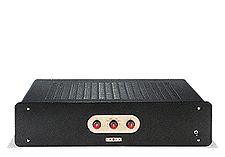
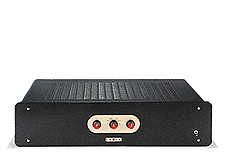
In a nutshell, the Chameleon is the company's £750 Vista power amp with the addition of four switchable line-level inputs. That's it. It's utterly minimalist, sporting what has been Croft's traditional front panel layout for some years: a rotary switch with muted positions between the source detents, flanked by left and right volume controls. (I long ago stopped arguing about the sheer, nay SADISTIC and BASTARDLY inconvenience on non-ganged, separate left-and-right volume controls. In their warped quest - under the guise of purism - for zero cross-talk or whatever else they feel separate volume controls provides, they continue this barbaric practice. And yet I don't see two mono chassis, two power supplies, two AC cables, two source selectors, etc. But they'll never give it up, so why bellyache?)
As with the Vista, it's all about minimalism and the removal of anything unnecessary. Sounds like Colin Champan and his quest for lightness when designing Lotus road and race cars. As the company puts it, 'It does not take a genius to know that unnecessary components in an amplifier circuit inhibit its performance. By eliminating these, the amplifier is free to express a kaleidoscope of sound.' They also announce, quite rightly, that another by-product of this is lower cost, so that impoverished music lovers can enjoy high-end sound for minimal outlay. If other makers and importers of affordable valve equipment question my continued support for Croft gear, when theirs may have more power or features or better looks, all I have to do is say, 'Listen to the Croft. And then send that self-immolating piece of crap of yours back to whatever third-world country you exploited in its manufacture.'
Take the lid off, and you'll marvel at the lack of PCBs and the presence of true point-to-point hard-wiring...something familiar only to those who either remember or still use gear from the classic era, or who build minimalist kits. Inside the 442x355x105mm (WDH) chassis are four ECL805 valves, 17 resistors, four coupling capacitors and proprietary, Croft-designed output transformers: truly simplified circuitry, with fixed bias operation.
Neither the Chameleon's innards nor its normal-phono-socket-and-binding-posts back panel is the place to hunt for trendy 'designer' names; Croft's magical skill has always been the ability to coax incomprehensibly fine performance from mundane parts. And you'd replace the components with costlier stuff - however easy and tempting that may be - at your peril. In this respect, Glenn Croft is like one of those tinkerers who'd turn up at motor races at Brooklands in the pre-WWII years with a 'special' made in his back garden, who'd then beat the pants off of factory-backed teams.
Supplied specs are as minimalist as the gear itself: input sensitivity of 0.5 mV, input impedance of 470k ohms and - most misleading of all - power output of 15W/ch. Fed with signals from the Sony XA333ES SACD player or the Marantz CD12/DA12 CD player, the Chameleon was connected to the obvious choice for such seemingly limited power: a pair of small Loth-X Ion Amaze two-ways known for their lack of hunger. As expected, all was well. But just out of curiosity, since they were there for the using, I set it up with B&W's much needier DM602 S3. And blow me down: the Croft was powerful enough to stretch my listening level tolerances with the controls at the half-way mark. So, clearly, 15 Croft watts aren't the same as, say, 15 SET watts. (Can you even get 15W out of an SET???)
Aide from an easily-curable hum from the cabinet - a VPI brick took care of that - no tweaking was required. Wires were Nirvana for the interconnects and Kimber Select for the speakers, and the unit sat directly on a GM Accessori table with no extras. (A brief session with the Relaxa 1 magnetic suspension table yielded a slight but audible improvement in focus.) Warm-up to optimum levels of performance was a mere 15 minutes. In effect, the Chameleon was as painless a component to set up and use as any integrated amp from a multinational giant.
Even so, you really do need to adopt a 1980s mind-set to 'bond' with the Croft: forget custom install and remote this'n'that and classy styling and everything else which has come along to lift purist audio out of the hair-shirt mire of the Flat Earth era. The Croft is unapologetically aimed at the sort of listener for whom multi-channel never existed and never will. Despite the ease of set-up, which is due as much to minimalism as it is to good design, the Chameleon has a way of letting you think that you're some hardy audiophile accustomed to sinking massive copper plates in the garden for earthing, or for moving your turntable stand onto a two-meter-thick concrete base. You can lie to yourself and think that you're a noble masochist, just be repeating; two volume controls, two volume controls, two volume controls...
Then you switch it on and wonder how something can be so-o-o musical yet so inexpensive.
Two things mark the Chameleon, two characteristics which make it so satisfying and - coincidentally and gratifyingly - are so in line with my personal preferences. The two areas which matter the most to me, above ludicrously pronounced bass or hyper-transparency, are a natural midband and a seamless (and therefore wide-open) soundstage. This pair of qualities seem to me to do more to make a system's performance 'convincing' than the rather 'hi-fi-ish' attributes of bass extension or transient attack.
Read more on Page 2
It took only the briefest burst of the SACD of Alison Krauss' 'Now That I've Found You' to hear that the Croft can do 'sweet' and clear with the grace of a 300B-driven amp, without exhibiting any traces of saccharine or fat. If the foodiness of that sentence bugs you, think of the Croft as natural fruit sugars while SETs can veer toward the teeth-rotting. It's warm, it's lush, it embraces you, but it's never smothering or schmaltzy. There's plenty of air accompanied by a compelling sense of space; you'll find even greater pleasure in well-recorded live albums, where the engineer understood the need to capture the venue. Check out the Corrs Live In Dublin or, if you prefer something of an earlier vintage, Poco's Deliverin'. It's almost enough to let you continue believing that two channels really are enough.
Within the soundstage, the Croft has the ability to portray convincing performers, each with his or her space and with satisfyingly lifelike height and mass. The ever-dependable Persuasions demonstrated this to good effect, especially in the way their voices blended while remaining distinct. This quality also allows the listener to home in on specific instruments, regardless of the number in the ensemble, such that the 'duelling' guitars in the Allman Brothers' earliest works and or the elements of the often-overwhelming wall of sound that is Wheatus' 'Teenage Dirtbag' can be savoured in isolation with even less work than it takes to focus on one of those '3D' optical illusions.
Just as computers find their own 'killer ap', so do hi-fi systems come alive with some musical touchstone. The track which smacked me upside the head, the single song which delivered even more of itself though I'd heard it a thousand times, was Squeeze's masterpiece, 'Tempted', which I was listening to again thanks to the new 2CD 'best of'. It's not even an overcrowded work, yet I swear the Croft unveiled minuscule details almost as a matter of fact rather than through artificial highlighting. And still it was more of a natural whole, less of a an-assembled-in-the-studio creation. Which is probably a roundabout way of saying that it sounded less like the mastertape and more like music. For some, that is heresy. For ye of limited funds, it's an invitation to the high end without the need of a second mortgage.
If you can afford a gilded lily, Croft will sell you a tweaked and tarted-up version with a luscious 12mm 'Baux' front panel, a stainless steel lid, paper-in-oil capacitors and other refinements for a still sane 1425. On the other hand, the beauty under review is yours for a positively embarrassing 875. And that's outrageously good value for an all-tube amp with the Croft pedigree. But the Croft doesn't have it all its own way.
Its main rival has to be Unison Research's astonishing Unico valve-hybrid integrated amplifier, which offers far more real power, better build quality, looks which won't have you grovelling for apologies and - for sofa-bound tubers - remote control. The Unison is the unit I'd recommend to ANYONE after an integrated for under a grand; it's a no-brainer choice. But if you're the sort who'd buy a Morgan instead of a Porsche just to be ornery, drink absinthe instead of scotch, holiday in Turkey rather than Spain, then the Croft is just that little bit more 'different'. Whatever way you cut it, the Chameleon is high-end sound with a mid-fi sticker. And you'll suffer absolutely no guilt about selling out to convenience.
