
Andrew Robinson began his career as an art director in entertainment advertising in 2003, after graduating from Art Center College of Design. In 2006, he became a creative director at Crew Creative Advertising, and oversaw the agency's Television Division, where he worked for clients such as TNT, TBS, History, FX, and Bravo to name a few. He now has one of the most popular AV-related channels on YouTube.
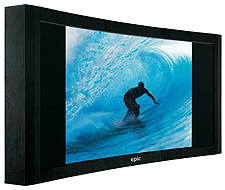
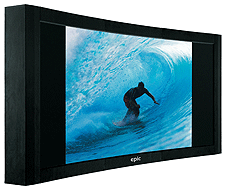
 The dnp Supernova Epic is designed to compete with the big boys in the world of home theater video screens. For those of you who may be caught unaware, dnp Screens is a screen manufacturer based out of Denmark that has predominantly been focused on making high-end projection screens for the professional, industrial and broadcast markets the world over. In the past few years, dnp has been coming on strong in the high-end home market with their Supernova line up of screens. Supernova is dnp's proprietary ambient light-rejecting projection surface that consists of seven layers of optical film, which doesn't simply diffuse ambient lightbut actually rejects it, meaning the viewer can watch a projected image in ambient light conditions, something you can't effectively do with traditional projection screens.
Focusing on the Supernova technology for a moment, beyond its seven-layer construction and ambient light-rejection capabilities, its black color layer allows the Supernova Epic to achieve superior contrast and color reproduction levels compared to the competition in both ambient and lightless conditions. The Supernova Epic is a 0.8 gain screen, making it ideal for a wide variety of front projectors, even those with seemingly low light output. Because of its superior color and contrast reproduction, as well as the fact that the Supernova material is completely color neutral, the Supernova screen is ISF certified. The Supernova material also allows for content to be viewed at a wider angle (up to 178 degrees) than traditional screens, meaning everyone in your theater or media room can enjoy the show regardless of where they're sitting.
While the Supernova classification deals only with the screen material itself, the Epic moniker is a whole other ball of wax and is equally impressive. The Supernova Epic is a native 2.40:1 screen that features pre-programmed auto-masking for a variety of standard aspect ratios, such as 4:3, 16:9, 1.85:1 and 2.35:1, as well as customizable aspect ratios, should you require them. The Epic's auto-masking utilizes two thin but rigid velvet curtains that open or close silently at the touch of a button or when commanded via a system controller (RS-232) or 12-volt trigger. The curtains can close completely, another feat few auto-masking screens can claim, for a true old-school cinematic presentation. The Epic comes in a variety of sizes, starting at 96 inches diagonal and ranging up to 156 inches. Custom sizes are also available, should you need something a bit larger. Prices start at around $16,500 for the smallest Epic screen and go up to around $26,000, depending on size and how you have your particular Epic screen configured.
The Supernova Epic can be wall-mounted or placed on a custom stand that dnp also manufactures. Obviously, you can have a custom furniture maker build something to accommodate the Epic's substantial girth as well. The wall mount retails for $535 and the custom stand ranges in price (depending on size) from $2,756 to $3,444. The Epic stand is an attractive aluminum structure that is very modern in appearance and sits low to the ground to ensure the proper height when viewing the screen from a seated position. All standard-size dnp screens come from the factory preassembled and ready for viewing, which is a wonderful feature; however, this does add a bit to the cost of shipping. A 156-inch diagonal dnp Supernova Epic will run roughly $2,300 to ship from Denmark to your door. Obviously, stand-mounting the Epic is the simplest way to go. Should you choose to wall-mount the massive screen, you'll want to employ the help of a custom installer, for the Epic weighs close to 300 pounds and should be built into a wall as opposed to being hung like a picture on top of it. Another reason why dnp recommends recessing the Epic screen into your wall is because of its nearly 12 inches of depth, which is necessary for accommodating its curving radius and auto-masking system.
The Hookup
Because the dnp Supernova Epic is so, well, epic, I was unable to demo it in my own home. I instead traveled to dnp's North American headquarters in Irvine, California for this review and my testing. I was able to view and demo a myriad of products that dnp is currently offering for the home and commercial markets, while calling the shots on my own sort of torture test, using some of my favorite demo software, comparing other screen materials and testing different lighting scenarios. Besides logistics, there was no way I could get this level of testing in my home lab.
dnp had a 132-inch Supernova Epic screen in their showroom situated on their custom floor stand, accompanied by a Digital Projection DLP-based projector with an anamorphic lens adapter capable of displaying a true 2.40:1 aspect ratio image. The seating position was approximately eight to ten feet from the center of the screen, with the projector resting a few feet beyond that. dnp was kind enough to have a 5.1 speaker system on hand for my review; however, I paid it little to no mind, for this was going to be a demonstration of the Supernova Epic's capabilities, not the speaker's.
The room was set up to control light and could be turned into a "man cave" at a moment's notice. There were numerous light sources, including nasty fluorescent lights, located throughout the room to demonstrate the Supernova's ability to reject harsh and ambient lighting conditions.
After I got the grand tour and a complete rundown of dnp and its vast product line, it was time for the main event.
Performance
I kicked things off with Cars (Disney) on Blu-ray disc and, within moments, Disney's iconic castle logo burst onto the screen. In order to test the Supernova material's light-rejecting prowess, I requested that the lights be left on. The image was shockingly bright, with tremendous detail and definition, despite the viewing conditions. Was it LCD or LED HDTV bright? No. However, for a front-projection set-up and given the conditions, the image quality was very impressive. The open scene of Cars features several black frames appearing between flashes of action as the lead character, Lightning McQueen (voiced by Owen Wilson), psyches himself up for the big race. The black frames were not completely black, but rather a very dark shade of grey (the screen's actual color) in the brightly lit room. It was during these dark frames that I noticed just how effective the Supernova material was at rejecting direct overhead light. Positioned above the Epic screen were two large banks of industrial fluorescent lights that were running at full tilt. While their presence was annoying (I hate all fluorescent lighting), they had no impact on the image itself. There was no visible light spill or reflection on the Supernova surface whatsoever. Also, the ambient light rushing in from the sides via a wall of floor-to-ceiling windows had little to no effect on the image. Truth be told, the fact that any image was visible under these conditions, let alone one that could be enjoyed, was astonishing. dnp states that the Supernova material was designed to perform, and perform well, in these conditions, because they feel it's unreasonable to expect every consumer who purchases a product to build a "man cave" around it.
Content with the Supernova Epic's performance under bright lights, I went ahead and had the house lights brought down to an ambient level, which consisted of closing the shades on the windows and turning off the fluorescent lights overhead. The room was still bright enough to read and write comfortably without fatigue. With Cars still playing, the image took on a new level of saturation, detail and punch overall. Black levels improved, getting dangerously close to true black, even in the ambient light conditions. It was at this point I took a large swatch of unity gain material dnp had on hand and held it up in front of the Epic screen. Wow. The image virtually disappeared when projected onto the unity gain surface. The side-by-side comparison wasn't so much a comparison as it was a statement of Supernova's superiority over traditional screen materials. It appeared as if I had cut out a section of the Epic screen and the image was displaying through the hole on the wall behind it. I removed the unity gain material and balance was again restored.
Read more on Page 2.
Following the unity gain test, I went ahead and watched for a moment in the ambient light conditions. Black detail was shockingly good, even with some lights on, allowing me to see fine details on the track's surface. Image, or should I say light uniformity, was incredible. With other curved screens I've demoed in the past, I've found the outer edges to be a bit duller than the center of the screen, which was not the case with the Supernova Epic. Keeping in mind that the lights were largely still on, there were no visible signs of shimmer across the Supernova's surface, nor did it impart any visible texture of its own to the image the way some fabrics or coated materials can. There was a level of dimension, sharpness and contrast I simply wasn't expecting, given the conditions. Not only could I watch the film in ambient light, I was able to enjoy it.
Lastly, I had the house lights brought all the way down, plunging the room into almost complete darkness. In the dark, the Supernova Epic's performance didn't elicit so much of a wow as it did a DAMN! The whole image seemed to figuratively float in space, thanks to the Supernova's ability to absorb and trap the light, as opposed to letting it spill and bounce around the room. The image was so vivid, so naturally sharp and punchy, it was better than even the best cinema I've seen in a long while. Blacks were inky smooth with tremendous detail, composure and dimension. White levels were brilliant without being harsh or aggressive. Colors, especially primary colors, simply popped like nothing I'd ever seen before. Everything, every little detail and texture, was brought into supreme focus and presented in such a larger-than-life, truly cinematic way that I was simply floored. I began to laugh.
Now I know many of you are thinking or perhaps even saying out loud, "Let's not overlook the projector." It's not like Digital Projection is a bargain basement brand. It is not. In fact it is, as we call it here at HomeTheaterReview.com, "super premium" - a grade of the best of the best. Yes, the projector is a factor in any front projection set-up; however, the screen is half of the equation as well. In the Supernova's case, it may be more than half of the equation. Even in a completely dark room, when I redid the unity gain comparison, the unity gain material appeared washed out in comparison. It was not subtle, I assure you.
Now, CG-animated fare like Cars is prime demo material, for it is overly saturated, punchy, sharp and clearer than what you're bound to see with live action fare. To be sure that the Supernova material wasn't just making already stunning source material look even better, I cued up a series of live action trailers for comparison. The trailer I focused on was for Enchanted (Walt Disney Home Entertainment). The film features several fairytale character clichés trapped in real-life New York. The live-action footage looked as good as the CG images from Cars. Skin tones were presented faithfully and realistically, with the same detail and dimension that again popped off the screen. Black levels were again extremely good, though more organic in nature, so not as inky smooth as what I observed with Cars. Edge fidelity was superb, giving the presentation true to life depth. Again, the Supernova material didn't inject any of its own character, be it color shift, texture or shimmer, to the projected image. I hate to use the window analogy when evaluating video performance, but due to the Supernova's ability to trap and hold onto the light from the projector, the image did appear to be a true window onto the cinematic event. It only took a few seconds, regardless of what was presented on screen, for me to become completely immersed in the experience, which is the best praise I can give any product, especially a projection screen.
I had the house lights brought back up to near-full (leaving the overhead fluorescents off, of course) and sat in silence as I gathered my thoughts. Ambient light-rejecting screens are nothing new; I use one in my reference home theater. However, none that I've encountered to date check all the appropriate performance boxes quite like the Supernova Epic. As a filmmaker, I spend a lot of time watching my content, as well as other filmmakers' content, on a wide variety of screens. While unity gain-based screens have served as the standard for many postproduction houses that I've frequented, I myself like to use ambient light-rejecting screens when screening or color correcting. There are a few things, such as texture and shimmer, with which my post team and I have simply had to make do. Not the case with the Supernova Epic. Furthermore, the Supernova Epic doesn't impart any color of its own, nor does it shift the color of the image, which is critical when considering a screen for postproduction applications. Because of this, the dnp Supernova Epic is quite possibly the only screen available in the home market that, when used with a high-end, properly calibrated projector will allow you to see an image that is closer, if not equal, to a director's intent than any other screen you can buy today.
The Downside
As far as I'm concerned, the Supernova Epic has no real downsides if you have the means and the room to accommodate it. It is one of the best, if not the best, projection screen I've ever laid eyes on. That being said, it's not going to be for everyone, for it is as its name implies: epic. The Epic's installation demands are not subtle, even if you're planning on placing it on dnp's own stand or something a bit more custom. This is a large screen no matter how you slice it and it should be installed in a dedicated media room or theater.
Furthermore, I don't think the Epic is the type of screen a novice or first-time front-projection consumer is bound to buy or consider. This is not an entry-level product. In order to take full advantage of its native 2.40:1 aspect ratio, you're going to need to outfit your projector with an anamorphic lens adapter, which isn't always compatible with budget or fixed-lens projectors. Clearly, consumers considering a screen like the Epic aren't rocking sub-$3,000 LCD projectors.
If you're looking for a native 2.40:1 screen that is more suited for a living room, dnp makes that, too. It won't have auto-masking, but it will be considerably cheaper and easier to install. Thanks to the Supernova surface, I'm not sure the absence of auto-masking will be an issue for the letter or pillar boxing that will appear along the sides and will blend seamlessly with the Velvet frame of the screen itself.
Lastly, you'll have to decide if a native 2.40:1 screen is right for your viewing needs. The vast majority of films coming out of Hollywood are 1.85:1 and most HD broadcasts are 16:9, meaning a standard 16:9 screen will more than fit the bill. Obviously, if you purchase a 16:9 screen, you're going to get letterboxing with native 2.35:1 or 2.40:1 content but you will save a few bills even if your 16:9 screen has auto-masking. However, if you want the real-deal Holyfield experience, a true, native 2.40:1 screen with auto-masking, like the Supernova Epic, is the way to go.
Conclusion
Let's not split hairs: the Supernova Epic from dnp Screens is, in fact, epic and designed for the enthusiast looking for the ultimate cinematic experience in the home. With a starting price of around $16,500, the Supernova Epic is not cheap. The Supernova Epic is designed to be the perfect all-around screen for the discriminating videophile and quite possibly the last screen such a person would ever have to buy. Its auto-masking system is the best I've seen, regardless of price, and enables the Epic, with its native 2.40:1 aspect ratio, to seemingly become four screens in one. Its ambient-light and even full-light performance is stunning, far superior to any ambient light or light diffusion screen currently on the market today. Turn the lights off, however, and the Supernova Epic's performance begs belief. If you can afford the dnp Supernova Epic and have the room to support it, I can think of no better screen to recommend for a dedicated home theater or media room.
Additional Resources
