
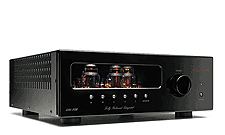
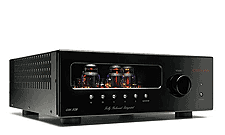

We all have favourites, even those of us who are supposed to be utterly impartial. Being only human (or so I'm told), I'm not going to hide my affection for GRAAF, a brand yet to disappoint and one of the first to demonstrate the Italian capacity for making sublime equipment. The company has, however, been unnaturally quiet of late, so I was more than a little relieved to learn of an all-new amplifier, not too crazily priced by today's standards, nor too cranky for non-masochistic audiophiles. In the GM50B, GRAAF has eschewed those astounding-but-pesky Russian 6C33C tubes-with-the-nipples, as well as its signature output-transformerless topology to frighten the weak.
Additional Resources
• Read more stereo amplifier reviews from HomeTheaterReview.com.
• Find an AV receiver to integrate with the amp.
• Discuss audiophile equipment on AudiophileReview.com.
On paper, then, the GM50B is conventional as it's basically a push-pull operation integrated amp with output transformers, a remote control to command source selection, power on/off, volume and mute, a single mains cable - nothing beyond its 30Kg weight and 450x160x500mm (WHD) dimensions can cause concern. Then again, 'GM' stands for Giovanni Mariani, and 'conventional' isn't in his vocabulary. Moreover, it doesn't look like a normal integrated amp - valve or otherwise - so you are advised from the outset to prepare yourself for something different.
GRAAF's goal was to include, in an all-valve, single-chassis product, 'the features and the level of performance that in the past were an exclusive of GRAAF [separate] preamplifiers and power amplifiers.' Thus it's unmistakeably GRAAF in terms of construction, sound quality and finish, but blessed with the lower cost, lower space consumption and ease of use of an integrated amplifier. It even features the company's trademark 'courtesy of Ferrari' paint finish, this time in black or silver.
Hopefully, this review will include some inside shots, because the interior is the stuff of a solder-head's dreams. Ordinarily, I don't get my rocks off looking inside amplifiers, but - as the lid had to be removed to check the valves - I'm glad I gazed on the GM50B's innards. It is simply unlike any other amplifier I've examined, the fit, finish and detail up and beyond even Nagra's. Or maybe I'm just a sucker for gloss-black PCBs filled with components installed with military precision. Hell, some of you will want to use this with the lid off, just to take periodic ganders at the insides. Think of it as you would a wristwatch with a glass back: something to ogle.
In the case of this GRAAF, there's glass at the front as well as inside. The 15mm thick aluminium front panel is fitted with a window for a view of both the internal circuitry and the output valves, Like McIntosh's MC 2000 and MC2102. Green LED indicators can be seen through the window, above the press buttons that select sources including two line level balanced inputs, three line level unbalanced inputs and tape monitor. A large rotary knob controls the volume. Lastly, there's a press button to take the unit out of stand-by; primary on/off is positioned on the back.
Also fitted to the rear panel are the XLR-type balanced inputs and RCA-phono socket unbalanced inputs, socketry for the tape loop, and an IEC three-pin mains input. GRAAF has fitted the GM50B with some of the best speaker terminals I've ever used: massive binding posts that accept spade connectors or banana plugs, spaced so that you can tighten them properly with special tools.
Mariani used some of the solutions fundamental to his OTL ranges, including a simplified layout with short signal paths and fully-balanced operation for two inputs to the output. Achieving this meant the complete doubling of the electronic circuits, including the option of connecting balanced sources with two pairs of phonos rather than XLRs. The circuit's first stage, for gain and impedance adjustment, serves the level control, the audio signal then entering a stage made up of two differential circuits in cascade, with the second working as the actual driver for the output stage. At this point the signals are compared each other and subjected to a further level gain. Two 6A30 drivers and four 6922s are used in the gain stages and as phase splitters; these work in Class A-AB mode and each of the valves has its own automatic bias control system.
For the output sections, Mariani chose the latest iteration of the Russian-made Svetlana KT88 tube, working in push-pull operation for a conservative 50W/ch, biased for A/AB Class operation. Extracting 25W from each KT88 means that the valves aren't anywhere near their limits, most designers dragging 50W from each '88 without any trouble. Each output tube also has its own automatic bias control system, a choice that Mariani believes will ensure the best performance in any operating condition.
Another GRAAF feature in the output stage is the use of transformers with earth connected to the central end in the secondary windings, a solution chosen to provide a true balanced configuration for the output stage. Also, this allows to obtain a balanced configuration for the feedback circuit. GRAAF explains that, 'Usually, in audio amplifiers, the feedback circuit brings back to the input only a part of the output signal, in a point defined as comparison knot. With this solution the GRAAF GM50B has two comparison knots for each channel, allowing it to have a balanced feedback net, more linear, precise and stable in its correction purposes. The GRAAF GM50B has a feedback rate limited to 12dB.'
Because I only had a short time with the GM50B and had to burn it in as well as audition it, I opted for two pairs speakers as far removed from each other as possible to provide a short-cut: my cherished 15 ohm Rogers LS3/5As and Wilson's WATT Puppy System 7, which are ostensibly a 4-8 ohm load of high sensitivity, but are demanding of the electronics. Sources included the Marantz CD-12/DA-12 CD player and the SME Series V arm with Koetsu Urushi cartridge, feeding the GRAAF via the EAR 324 phono stage. And although I played with the unbalanced inputs, this amplifier begs to be heard in fully balanced mode. So my choice of sources was deliberate, both Marantz and EAR providing balanced output.
At switch-on, the GM50B goes into a mute phase until all the valves reach the correct operating temperature. This is brief, a minute or two, but the importer's pleas regarding burn-in were genuine. The GM50B needed around 72 hours solid, which meant letting it play through the night with CD in repeat mode. The sound 'loosened up', the amp seeming more free and easy, certainly more open-sounding, and you could hear it just get better and better. Which makes me wonder: why the hell doesn't GRAAF (and every other manufacturer) burn in their products before despatching them to the end user?
Anyway, I wired the lot up with Transparent Reference wiring, plugged the amplifier and the EAR phono stage into the mains ring wired with Siltech and the CD player into the ring wired with Transparent. And despite hearing the system for a few days during the burn-in, I genuinely wasn't prepared for what I heard when the time arrived for serious listening.
Let me explain: Although I checked on the system from time to time, I wasn't paying 'reviewer attention' to it. Sure, I suspected that it was a nice, pleasant machine, and it showed no grounds for concern when moving from the Wilsons, with their impedance dip down into amp-eating territory, to the LS3/5As. When I finally sat down with a stack of CDs and LPs, cueing up Howard Tate's Get It While You Can (the first Verve stereo pressing), I experienced what can only be described as a satori. It was one of those sessions that usually occurs, oh, ever five years. Tate's voice was front and centre, palpable, with all of the textures reproduced to the most lifelike degree one could demand. It's a record I've played more than any single LP in my collection. I have a half-dozen pressings and two different CDs of it. I thought I knew every nuance. I was wrong. And here it is in the same calendar year as the Sonus Faber Stradivari (and something I'm reviewing next month that will tap out my Mastercard). So much for the five-year gaps between miracles.
Read more about the GM50B on Page 2.
It's like this. As a spoiled-rotten reviewer, I get to play with
toys way beyond my pecuniary status. I know this, and never allow
myself to forget it. Luck of the draw, I suppose - I could have ended
up teaching English to a bunch of knife-wielding little bastards at a
comprehensive. Because I'm nothing like far too many of my colleagues,
who contradictorily write about luxury goods while espousing Marxist
cant, I suffer no guilt and simply consider myself to be one lucky
sumbitch. Why? Because it comes with the territory, like getting a
discount at M&S if you work there. Anyway, my normal ride is the
aforementioned SME/Marantz/Wilson mix, with the sublime McIntosh C2200
preamplifier and MC2102 power amplifier in-between. And that pairing,
which continues to amaze me, costs around 12,000 - serious money by
any standard (yet only entry level when you look at the price of
Halcros, the top Krells, WAVAC, ad summum).
With the GRAAF GM50B integrated amplifier, which drives the LS3/5As
as if it were a Radford STA25 Mk III and handles the Wilsons like an
Audio Research VT100, you get similar, first rank, pedigree'd
performance for 3950. And that's with a pre-amp thrown in to the mix.
Plus remote control, and perceived value so far beyond what most of the
traditional high-end brands offer that it's almost painful. No sharp
edges, runny paint, ill-fitting screws, malfunctioning controls. No
buzzes, farts, sneezes, hums or crackles. Just deliriously realistic
music against a black, velvety background.
It continued with a batch of discs I was reviewing at the time,
including Alison Krauss' So Long So Wrong on vinyl and - more
importantly - Crosby Stills Nash & Young's Déjà Vu, the Classic
reissue of which I had to compare to a mint original pressing. This, in
some ways, is even tougher than comparing amps or wires or speakers
because you have to account for wear and tear on the original, the
shape of the master tapes vis a vis the reissue, and other
imponderables. I'm also on a mono kick at the moment, so I was working
my way through multiples of the Capitol Mickey Katz LPs to find the
best copies.
I'm glad I started with the vinyl. The GRAAF GM50B, despite its lack
of a phono stage, has an affinity for the capabilities of LP playback,
including the treble sweetness, the more seamless transitions across
the frequency range, the openness and air, the sense of space, the
non-aggressive lower registers. And because Mariani has no truck with
valve noises, he's created an untainted background against which to
reproduce the music. However magnificent the Classic replica of Déjà
Vu, it was abundantly clear that the original exhibited subtleties that
simply aren't present on the newer edition. Regardless of the speaker
load, the GRAAF served as a clean conduit, the path it carved favouring
the acoustic guitars and the occasional pedal steel on CSN&Y's
sophomore masterpiece. It enabled me to gauge the levels of
transparency between the two pressings, a characteristic so subtle that
it could even be obscured by a change of cables.
But not once did it resemble listening through a solid-state
package, which, most of the time, will better valves for hygienic
precision while, alas, sounding too clinical at the same time. However
confusing this may seem, the GRAAF always sounded like a valve
amplifier, whether being driven hard to genteel clipping or operating
at near-whisper levels. In this respect, it aped the McIntosh package,
which I swear by because of its positioning between valve and
solid-state sounds...and I mean its ability to copy the Mac's marriage
of the best of both and the worst of neither. It was only under extreme
conditions that the McIntosh showed the GRAAF's limitations: absolute
power, the speed and control of dynamic swings, bottom octave slam. But
the GRAAF, under normal conditions, rarely reached its limits. (Which
means that the GRAAF just may be a spoiler for McIntosh, who have just
released their first-ever all valve integrated amplifier - a wonderful
coincidence!)
Where the GRAAF really scores, though, especially related to its
price, are the sense of power it imparts within the anticipated
performance of a 50-watter, and the scale it produces. No kidding: the
GM50B drove the Wilsons to levels I would never credit from an amp
below 100W. At the same time, it assembled a sound stage that was both
vast and correct, utterly convincing in terms of dimensions and ratio.
During my spell with the GRAAF, some seasoned listeners heard it,
veterans with extreme systems. They were gobsmacked and all agreed: as
astounding as the PrimaLuna Prologue One is for 799, so is the GRAAF
rewriting the rules in the sub- 4000 bracket. I don't give a damn what
hostility this creates - and I do expect to receive the odd nasty,
disgruntled phonecall from rival makers - but I'm telling you this: the
GRAAF GM50B amplifier is a Mariani tour de force at FIAT prices.
Additional Resources
• Read more stereo amplifier reviews from HomeTheaterReview.com.
• Find an AV receiver to integrate with the amp.
• Discuss audiophile equipment on AudiophileReview.com.
GRAAF GM50B SPECIFICATION
Power Output 50W into 8ohms
Input Sensitivity 500mV
Frequency Response 10Hz-100kHz (0.5dB/1W)
Signal/Noise Ratio 83dBA
Total Harmonic Distortion 0.3% (10W)
Negative feedback 12dB
Weight 30Kg
Dimensions 450x160x500mm (WHD)
Price 3950
