

It's no secret the film industry is hurting these days. While the month-to-month theatrical earnings seem to fluctuate compared to previous years, overall earnings are down. Home video is no different as DVD continues its downward spiral aided by the confusion caused by the introduction of Blu-ray and a shaky economy. Film downloads are on the rise, but they have failed to ignite a firestorm in the manner of their musical counterparts. In response to the growing crisis, small studios or mini-majors have closed their doors and the larger studios and distributors have ceased production and development on future projects for up to two full years, as well as laid off scores of loyal employees.
As a filmmaker, the rapid decline of Hollywood is a bit unnerving, but not wholeheartedly unexpected. Beyond the current economic climate we find ourselves in, which has had a profound effect on seemingly everyone from Hollywood to Joe the Plumber, I can't help but think all of this, or at least most of it, could've been avoided. Hollywood is banking heavily on 3D to pull theatrical sales out of the toilet and, on paper, it appears to be a good strategy. However, this still doesn't solve Hollywood's problems with home video and the rise of Internet-based video services such as YouTube and Hulu. For decades, home video has been the bread and butter of just about everything Hollywood has to offer. Home video has been the life's blood of the film industry since VHS and what home video couldn't provide, international sales could. With both home video and international sales sinking faster than the Titanic, the studios have begun taking a hard look at the Internet and subscription-based rental services and they don't like either of them one bit.
Well, allow me to clarify a bit. I'm not certain Hollywood hates the Internet or rental giants like Netflix, I just don't think they understand them. Or at the very least, they don't understand why consumers love them so much, because if there is one concept Hollywood can't wrap their collective brains around, it's "affordable" or, better yet, "cheap." The idea of "cheap" scares Hollywood, because for eons, they've solved problems by throwing money at them. Bad test screening results? Spend more money on flashy advertising. Poor international sales? Spend more money to get four bankable stars in the sequel, rather than the two who were in the first film, and so on and so forth. The problem with cheap isn't that Hollywood can't make money on anything, the problem with cheap is that they can't make back all of the money they've spent.
Case in point: the Tribeca Film Festival ended not to long ago and played host to a number of independent and studio films, many of which were still for sale in some capacity or another. Because of the bad economics plaguing the film industry right now only a handful of films sold at the festival. Magnolia proved to be most eager to acquire content this year, though no film, not even ones with a bit of star power and press behind them, sold for more than low six figures.
While it may seem like Magnolia and a few other mini-majors got the deal of the century, they still have to spend upwards of a million dollars or more, on top of the acquisition cost, to market the film to the consumer. With independent film revenues down both domestically and internationally, it could be years before Magnolia sees a profit, despite the low cost of acquisition compared to that of costlier big-budget films. Never mind the fact that the filmmaker may still be upside down their investors even with a sale to a reputable company such as Magnolia. This is why so many in Hollywood are sleeping with a loaded gun under their pillows at night thinking to themselves, "If it gets any worse ..."
Now, I'm not going to necessarily shed a tear for the Hollywood power brokers, for they've had it good for a very long time, but like I said earlier, a lot of what they're going through could've been partially if not entirely avoided, which brings us to the Internet and subscription-based rental services, such as Netflix. These services are nothing, new yet if you read the trades, many Hollywood insiders talk about them as if they woke up this morning to discover there were consumers out there downloading content via their computers and getting movies delivered to them in the mail. To quote Keanu Reeves, "Whoa."
However, the Internet isn't just another thing Hollywood can take over with money, though I'm sure it sometimes looks that way. The Internet is still the Wild West in many regards. As in the real Wild West, the rules can and do change. The other thing about the Internet, and the inherent problem Hollywood has with it, is the fact that it's somewhat the embodiment of "free," or at the very least "cheap." It started earlier in the days of DVD, with dotcoms like Amazon undercutting retail disc prices by significant margins, and has evolved into the 99-cent download and free play through services like Hulu. In a world where content is priced below a dollar or for free, how is Hollywood supposed to make any money? Compound the Internet problem with the growing threat from kiosk services like Redbox, which charges a dollar to rent a DVD, whether it's a new release or a library title, and the perceived trouble only gets worse for Hollywood. Hollywood's first real attempt at utilizing and monetizing the Internet through their partnerships with iTunes, YouTube, Hulu and the like isn't going completely to plan, because they wanted to have their cake and eat it, too.
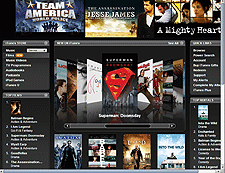
Hollywood opened up their vast libraries to the Internet, but priced the titles at such a premium that it is actually confusing to consumers. iTunes currently sells major studio films for anywhere between $9.99 and $19.99, depending on the resolution and relative newness of the release. For your money, you get convenience wrapped in some of the dumbest copy-protection known to man, as well as lower-quality audio and video, compared to standard DVDs. With the release of iTunes 9, many new films now come standard with bonus features like deleted scenes, outtakes and more, making the value proposition a little stronger for downloads. However, there's no denying that many consumers like to own something physical if they're spending any sort of money and, in this economy, you better believe that $10-$20 is real money. However, even with all the bonus features, the downloads still cost more, in most cases, than a new release of the same film on DVD, which can be ripped easily and shared across a wider range of portable devices and products without having to do the stupid DRM dance. Don't even get me started on Blu-ray. Furthermore, many consumers don't want to buy anything right now and have flocked to rental services like Netflix, which offers monthly plans that start at around five dollars. Five dollars and the movies come straight to your door? iTunes who?
On top of all of this, sites like Hulu offer full-length films for free. With many of today's consumer electronics hardwired to stream content from the likes of Hulu or YouTube (which also offer feature-length studio films), the idea of spending money on a movie in the future may go out the window altogether. Even so, there is a silver lining in all of this, a sign that customers are still willing to pay something for their entertainment: music downloads. Hollywood is currently experiencing what the music industry went through a few years ago when they went toe to toe with the Internet, and the lesson they learned was simple: fewer artists, lower budgets and 99 cents. Also, they took a cue from their own artists and began taking ancillary goods and services seriously as well. Hollywood isn't experiencing a new phenomenon, though they'll say they are; they're simply going through the growing pains and the learning curve the music industry has already endured.
It's not impossible for Hollywood to rebound and rise above their financial woes; it's just going to take a slight adjustment in thinking. The idea of cheap equaling bad is no longer the case. Cheap equals a sale right now, and with regard to the Internet, that will always be the case. The Internet is the people's playground and, while there are those who seek to patrol and police the Net, they're not on the scene yet, so for the time being, consumers will have it their way. Downloaded movies have to be priced below physical media, 99 cents for rentals and $4.99 for purchase, if they're going to have any real chance at becoming the medium of choice in the future. Along with lower-priced downloads, Hollywood needs to open up more of their libraries, especially their new releases, to services like Hulu and YouTube, because not only will it generate them more money, but it will grow their fan base and, when it comes to the Internet, you can never have too many fans.
While Hollywood can make their goods available to consumers at far more advantageous prices, they'll also have to lower the amount they spend to make said content. At the very least, Hollywood will have to make fewer films that are of higher quality, turning the theater/viewing experience into more of an event, as opposed to treating the theaters or your living room like a parking lot to sit your butt in for two hours on a weekend. And no, 3D isn't the solution, and no I don't need to see 20-year-old John Hughes movies in 3D because you say so. 3D is great, but it is not Moses come down from on high, for the root of the problem isn't relegated simply to theaters or finding new ways to skin the same bald cat.
I'm often asked why I choose to remain in the film business and Hollywood, given all the reports telling me to get out now while I still can. Simple, people will always need and crave entertainment and I don't believe movies will ever die. The format might change, as will the venue, but the basic premise of visually telling a story to another will remain and that's what gets me out of bed in the morning. The rest of this stuff, while sometimes unnerving, comes with the territory and, if I'm honest, is all rather exciting.
