
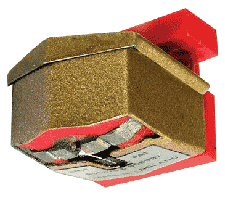
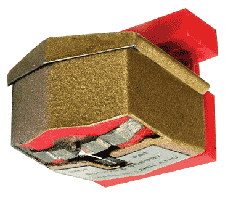
 With the plethora of audio toys which surrounds reviewers, it's easy for them to forget what they once worshiped. Me? I was a Decca cartridge addict of such feverish devotion that I'm embarrassed to admit that I hadn't really looked at the line since I reviewed the (London) Jubilee back in '92. '92!!! Mind you, I described it as, 'the very best cartridge Decca didn't make.' Miraculously, that cartridge is still available, still £999, and still 'the very best cartridge Decca didn't make.' But now the Super Gold is almost as good. At less than half the price.
Additional Resources
• Read more source component reviews from HomeTheaterReview.com.
• Find a receiver to pair with this source.
• See more about the audiophile world at AudiophileReview.com.
• Discuss all kinds of gear at hometheaterequipment.com.
For those who need a primer, the Super Gold was/is the ultimate incarnation of what was the Decca London, with the blocky 'tin can' body which provided so many audiophiles with so much laughter over the decades. The Jubilee, on the other hand, was/is what Brian Smith and cohorts figured, after they took over production under the London banner, what the Decca might have become had it been further developed with post-1978 attitudes: computer-machined, solid aluminium body, no resonance, total rigidity. And although it answered nearly every Decca-lover's prayer, some still preferred to have their cartridges housed in tin cans. Dunno what it is: maybe there's a sense of 'Britain of yore' when it looks like your cartridge was fashioned by someone using tin snips. Categorically, if New Labour ever learns of the London cartridge, it will have it banned, to join the red phone box, and - eventually - the pound sterling and the House of Lords.
Now, the reason for this review: Presence Audio and the guys who make the London (and still supply a disarming array of original whack-o Decca accessories like the Deram carbon fibre brush, the Record Grip, etc) decided an upgrade was needed to carry the Super Gold into the 21st Century. What they did, to my trouser-tightening glee, was to ditch the edgy van den Hul tip, which I always thought sucked big time, and replace it with the extended line contact stylus used on the Jubilee.
Briefly, the Super Gold uses the same motor system and L-shaped cantilever of the Decca era cartridges, with near-vertical positioning nominal compliance and the sort of built-in fragility which guarantees breakage. As with every Decca/London, the cartridge works best in an arm with adjustable damping to deal with the rattles and hums. Although I use the SME Series V arm for virtually ALL my listening, this time I opted for a proper Decca International, on the Garrard 401 in Slate Audio plinth. Tracking was set at 1.8g. No extras like the Decapod were used; instead, I fitted it to the drilled metal replacement headshell available for the International, with the cheesy red plastic bracket. It works best with 47k ohms, so I fed it into the Nu-Vista M3 integrated
Oh, the shame! Why have I been denying myself this scintillating, shimmering bliss for so many years? Why have I even pissed around with moving-coils? Clearly - no,
'Zingy' is the vibe, 'dazzling' - like a mouthful of sweetshop sherbet, with the treble taking on a sparkle which glistens and tingles. Forget sibilance, dismiss notions of the Wilson's Frenc-made tweeter going into advanced fatigue mode: Decca/London treble is as captivating as Kate Winslet's smile. And its bottom is just as rounded.
As is traditional with all Decca/London derivatives, when they're operating in a perfect environment, you will hear the most realistic strings and vocals imaginable. The key, though, is this almost unattainable, ideal set-up, so hard to achieve that it bests most so-called audio wizards. What the new tip does is make set-up easier, more consistent, more repeatable; with van den Huls, you just don't know when it's gonna go all screechy.
Read more about the Super Gold cartridge on Page 2.
But is there a down-side, compared, say, to the Jubilee, which avoids recalcitrant humming and buzzing? This cartridge is nowhere near as prone to misbehaviour as the classic Deccas; then again, my Garrard 401 is mint, the arm is as-new, the wiring shielded, the plinth bordering on the anally-retentive. The new Super Gold just didn't give me the sort of grief I expected, which is not unlike returning to a pre-computerised-engine-management car like an MG-B, after a life in any made-in-the-1990s real world vehicle. It never skipped, it never crackled, it traced those grooves like Schumacher at the Nurburgring.
But, aah, you're thinking. Kessler is trying to make out like the London is a normal cartridge, for normal people. It isn't. If you need security and peace of mind and easy set-up, stick with conventional moving magnets or m-cs. (Or CD, for that matter.) And the best - recent Grados, Lyras, Koetsus -
There's another way to look at it: there's no other way you can get this much adventure from the comfort and safety of your listening seat for a mere 439. The rest of you: use the 439 to go bungee jumping.
Additional Resources
• Read more source component reviews from HomeTheaterReview.com.
• Find a receiver to pair with this source.
• See more about the audiophile world at AudiophileReview.com.
• Discuss all kinds of gear at hometheaterequipment.com.
