

Trying to stop Musical Fidelity's Antony Michaelson from pumping out new models is like trying to get the Labour Party to stop spinning. At least this time, there's an irresistible hook: 2002 is the company's 20th Anniversary, and Michaelson wanted to mark it in style. Unbelievably, he's repeated the brilliant coup which enabled MF to produce the most highly-acclaimed models it has ever released: the Nu-Vista amps and CD player. He's gone out and found a finite supply of another obscure valve.
Additional Resources
• Read more stereo amplifier reviews from HomeTheaterReview.com.
• Find an AV receiver to integrate with the amp.
• Discuss audiophile equipment on AudiophileReview.com.
Don't confuse this with some unknown Japanese amp maker finding 16 pairs of some pre-war triode, enough to make, say, eight amps for friends (and a journalist or two). No way: Michaelson buys his valves in the thousands. This time, it's a cache of subminiature tubes designed for military use. But - unlike nuvistors - they need no valve bases; MF's biggest headache with the nuvistor was the scarcity of valve bases. Instead, they are hardwired via five filaments exiting from the bottom of the glass envelope; [See sidebar: What Is A Trivistor Tube?] The Tri-Vista 300 Integrated Amplifier is believed to be the first to use these tubes in a commercial audio product, but I have no doubt that some eagle-eyed and elephant-memoried reader will recall some near-forgotten phono amp or some such which used them, too. To be honest, they looked to me like something you'd find in a valve microphone.
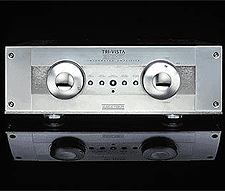
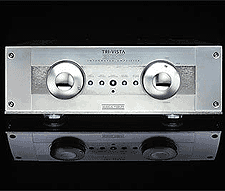
Unsurprisingly, the 300 immediately calls to mind the Nu-Vista M3 integrated. But there are plenty of visual changes, not the least being the removal of the gold trim which made the Nu-Vista look like it was designed to satisfy the aesthetic concerns of a pimp in 1970s Miami. Moreover, there's a new light show, bigger knobs and - overall - a more luxurious look. In fact, the whole thing seems bigger, even though the size is the same as the Nu-Vista's.
For starters, the outboard power supply is a beast at 14x6 1/4x9 5/8 in (WDH), and - as there's no remote power on - you'll need access to it for switch-on. As with the M3, it connects to the main unit via three cables for left-and-right power and a control cable. The 300's back panel contains industrial connectors for the power supply, a bank of phono connectors for five line sources, a damned quiet phono stage (plus earthing tag), tape in/out and pre-out, and two pairs of massive multi-way speaker binding posts to facilitate easy bi-wiring. Though the main chassis measures 19x6 1/4x16in (WHD), allow 20in depth for the fittings. Across the front, sexy in various shades of silver and titanium, are a mere three controls: rotaries for volume and source, and a press button to choose tape monitor. This is flanked by four blue lamps to tell you that the pre-amp and power stages are working properly.
Then there are the feet, which change colours from red at switch-on to orange-y amber when the circuits settle to a blue-y mauve after complete warm-up. OK, so this sounds like sheer recidivism after the move away from the Versace-slave/fashion-whore-gilding tack of the Nu-Vista, a gimmick unworthy of a serious product. But even my most cynical audiophile friends had to admit: turn out the lights and it looks cool as hell, in a Close-Encounters-mothership-taking-off way. Makes me wanna reach for a Thai stick.
Easier to justify is full remote control via a hand-held which contains controls for other MF products, including the forthcoming SACD player. Peculiar, though, is the need to fire it directly at the Tri-Vista for the remote to work, something which made me miss the radio (rather than IR) remote of the Unison Research Unico. My only other complaint about presentation is MF's continued usage - inexcusable after the lozenge-shaped Nu-Vista separates - of sharp-edged heat-sinks which surely break some EC safety law. In future, I will name and shame amplifiers which bear lethal heatsinks; there are no excuses for NOT rounding the edges.
Rated at a ferocious 340W/ch and able to deliver 40 amps of peak current, the Tri-Vista will drive anything you care to throw at it. Hungry though the Sonus Faber Guarneris may be, they never taxed the amp, nor did the high-sensitivity-but-tricky-load Wilson WATT Puppy System 6. Intriguingly - and, I've no doubt, to Michaelson's dismay - I turned up one of those truly unlikely matches made in heaven. It's like this: Michaelson has so fallen in love with the Sonus Faber Cremona that he bought a pair and sings their praises at every opportunity. You'll hear no complaints from me, for I agree. But, while reviewing the 300, a pair of this year's Bargain Speakers turned up, what I believe to be a Wharfedale Diamond 8.1 For Grown-Ups. No surprise, here: the little gem was designed by the same genius who penned the Diamond.
So, a brief aside: Quad's new £500-per-pair 12L is so deceptively 'high end', so big-sounding and robust that hammering it with the Tri-Vista resulted in no broken drivers, no scraping voice coils, no fried crossovers. That it did justice to the Tri-Vista in no way undermines the amp; it merely reinforces the notion that speaker size and price mean little. I just thought you might like to know about another magic package which no retailer in his right mind would ever consider demonstrating, as the Tri-Vista, by virtue of power and price, begs a demonstration with £3000-per-pair-and-up speakers. End of rant.
Effectively a dual-mono design with an absurdly over-the-top power supply and with each channel enjoying its own PCB, heatsink, choke regulation and mains transformer, the Tri-Vista seems incapable of running out of steam. It's quiet, easy to listen to for three-hour-plus sessions, operates with a silky smoothness (you'll find it hard to resist changing sources for the hell of it, just to see and hear the motorised rotary-control in action) and seems immune to accidental abuse, such as switching off the mains at the wall or yanking out a cable in haste. Musical Fidelity addressed all manner of concerns which deal directly with safety and security, as well as with immunity to external influences, so the external power supply is no mere conceit.
Read more about the Tri-Vista 300 on Page 2.
Being an integrated amp, it boasts what no separates can: absolutely
no interface problems between preamp and power amp because the output
stage of the former is optimised to drive the latter. It's an argument
even separates supporters such as I cannot deny, but it's indicative of
both the increasing popularity of high-end integrated amps and the
appearance of so many superb examples of the genre over the past two
years. MF also prefers such practices as employing minimal levels of
feedback, a completely separate choke-regulated power supply for the
output stage and completely separate power supply for the driver stage.
And what a pay-off! The Tri-Vista behaves more like a big mutha
pre/power combo than any of the super-integrateds I've reviewed lately,
especially in the way it acts like it respects neither boundaries nor
limitations. I don't know if sheer force was as much a part of the
design brief as finesse and delicacy - they're of equal worth in the
Michaelson canon - but the Tri-Vista exhibits a sense of brawn which
places it above nearly all of the other integrateds I've tried. It
certainly stomps the Pathos Logos also reviewed in this issue for
grunt, but it is, equally, lacking much of that amp's warmth. So,
before we go any further, let's make this bit perfectly clear: if you
need an amp with plenty of muscle and simply cannot or will not offer
shelf space and AC sockets to two components, put the Tri-Vista on your
list. It's also the primary gain, though there are other less
significant ones, over the still thrilling Nu-Vista M3 integrated.
What the grunt has to do with the 5703 valve itself is negligible;
rather, it's a by-product of the output stages and the power supplies,
the 5703's role occurring before that part of the chain. Oddly, given
the more tube-like appearance and nature of the 5703 itself over the
nuvistor, the Tri-Vista exhibits less valve-like behaviour than the M3,
as cited above with the delicious Pathos Logos.
A Tri-Vista 300 will set you back 3,995. For the money, it's a
champion, able to strut its stuff around 6000 pre/power combinations
and, in terms of sheer power, run rough-shod over any other integrated
amps I can name. But it has a more forceful, distinctive personality
than, say, the Nu-Vista M3, that amplifier being its clear antecedent.
The 300 imposes itself on the signal in ways some may find
disconcerting at worst. Conversely, the three areas where it really
pees on the tree are its sense of three-dimensional space, its bass
extension and power, and transient attack. Combine the three, and
you're talking about an amplifier begging to rock your world.
Take, for example, the newly restored, cleaner Rolling Stones
recordings on the 40 Licks collection. Note that this is a CD, not part
of the SACD reissue programme. And, yet, side-by-side, the Tri-Vista
made the CD sound more like an SACD than ever would I have imagined,
nearly matching the SACD's slam and lack of grunge. Honky Tonk Women,
though notorious for its tape hiss, is a perfect example of how the
Tri-Vista deals with every aspect of the reproduction of percussion,
slam and transient behaviour. The cowbell and kick-drum at the
beginning, the sharp, distorted twang of the guitar - each has its own
space, its own textures, its own damping, the instruments floating
there for you to home in on, but still part of a cohesive whole. No
break-up, no congestion, and yet there's so much going on in the that
track you can only wonder how it's all juggled with such ease. Just
like the SACD, in fact.

A more delicate work, 'Mean Old Man' on James Taylor's new CD,
October Road, starts off with a wash of silky strings and an acoustic
guitar, followed by a some jazzy piano - very Chesky-like and glossy.
You discover immediately that there's more warmth to be had from the
Nu-Vista, but the Tri-Vista's portrayal, just because of its greater
openness and 'cleaner' air, somehow seems more intimate. Why? Because
you can 'feel the space'.
Calling the shots on this amp is tough. It clearly excels for
conveying a sense of majesty. It has energy galore, lower registers
which will wrest tears from fans of Kodo drumming. It impresses on
every level. But it is not warm, fuzzy and cuddly. It does nothing to
ameliorate treble excesses, it will not gloss over anomalies with
euphonic sleight-of-hand. Thus, it's a more difficult, less forgiving
amp to possess than the Nu-Vista, the Pathos Logos or even rivals from
Gryphon and McIntosh. But, leaving its martinet mien aside, I suspect
the Tri-Vista 300 may emerge as a highly-coveted future classic.
WHAT IS A TRIVISTOR TUBE?
In Yiddish, it's called a 'bobbe meisse', an old wives' tale. Clearly,
Antony Michaelson was so excited by the prospect of finding another
rare valve that he swallowed his supplier's sales pitch hook, line and
sinker. At worst, someone was responsible for coining a terrific name,
one which follows perfectly the very real 'nuvistor', which was turned
into the canny 'Nu-Vista' for marketing purposes. What better to follow
'Nu-Vista' than 'Tri-Vista'?
Alas, there's no such thing as a trivistor. Instead, this tube is a
very real, if obscure model called the 5703WB - hardly a name which
rolls off the tongue. But the 'tri' is apt, for the valve IS a triode.
According to Raytheon's technical data sheet, dated 1, April, 1957
(and, no, it's not an April Fool's gag), 'The CK5703WB is a
heater-cathode type medium-mu triode of subminiature construction
capable of operating as an oscillator, Class C amplifier or frequency
multiplier in the UHF region.' The boxes housing the Musical Fidelity
stock are marked 'JAN', which my sources tell me is shorthand for
'Joint Army Navy'. And even if that's a bobbe meisse, too, there's no
mistaking what was on the original shipping labels: New Cumberland Army
Depot. [See photo.]
This valve was, apparently, designed for military use only, its main
strength being extreme ruggedness, with special immunity to mechanical
shock, vibration or high temperatures. Whatever you may or may not hear
about the 5703, it should last a long time, maybe even longer than a
nuvistor. One thing's for certain: since it comes in a glass envelope,
it even looks more like a valve than does a nuvistor.
Musical Fidelity acquired its stocks in late 2000, eventually using
them as the heart of the 20th anniversary Tri-Vista series. There are
enough 5703s to produce 500 integrated amplifiers, 800 SACD players,
300 preamplifiers and 300 power amplifiers. As with the nuvistors, the
company has enough 5703s to supply a spare set for every unit made.
By the way, the batch that Musical Fidelity purchased was, according
to the packaging, manufactured in 1982, the year that Musical Fidelity
was founded. As Michaelson, ever a marketing wizard notes 'Perhaps fate
had already lined them up for us back then?'
Additional Resources
• Read more stereo amplifier reviews from HomeTheaterReview.com.
• Find an AV receiver to integrate with the amp.
• Discuss audiophile equipment on AudiophileReview.com.
