
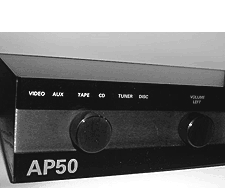
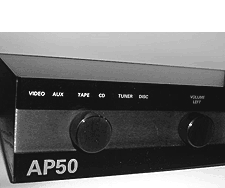

How refreshing it is to see, amidst a plethora of amps so cluttered as to be rococo, a return to good old-fashioned British minimalism. Not that NVA is completely innocent of the charge of producing what in the world of watches are called 'complications'; the company's flagship models are as ornate, stylised and over-engineered as any Japanese single-ended triode amplifier or computer-driven solid-state behemoth from America. But NVA's AP50 integrated amplifier is a dose of sanity as the hi-fi buttons'n'knobs count increases with the number of surround-sound formats on offer. This thing is so cleanly styled that it'll confuse those introduced to audio through an A/V receiver of post-1990 construction.
Additional Resources
• Read more stereo amplifier reviews from HomeTheaterReview.com.
• Find an AV receiver to integrate with the amp.
• Discuss audiophile equipment on AudiophileReview.com.
Then again, it's not surprising, as Richard Dunn is this industry's self-appointed bullshit filter, author of numerous missives protesting one thing and another. But he does practice what he preaches, and the AP50 is as free of taurean faeces as is possible without eliminating basic operations. Even the on-off toggle has been relegated to the back panel, which houses only the requisite (gold-plated) sockets for the six sources, the tape loop ingress and egress, and speaker sockets which accept only the near-to-extinction banana plug. The front panel bears but two large knobs, one a nicely weighted device for altering level, the other for selecting the source. As the front panel is made from black perspex, NVA has used this to good effect by including a tiny red LED to indicate on/off status in a most tasteful manner. But it won't cause palpitations among those who get their rocks off by switching off the lights to watch their hi-fi systems' luminous capabilities. All we're talking about is a tiny red dot.
Er, that's it. The unit is so clean and simple and nicely finished that, were the dealer to cover the NVA logo, you could easily mistake it for a Densen integarted amp or some other device of the Scandinavian persuasion. This amplifier is a tonic for those fed up with clutter, a throwback to 1983 and the days when anyone using a source other than a turntable was deemed an
In the form which arrived for the review, the AP50 bore six identical line inputs, hardwired to the selector switch. NVA - as cable-sensitive a company as I've ever faced - uses silver alloy with a PTFE cover at this stage. The output of the source switch is fed to the volume control and tape sockets, again via silver wire. The potentiometer is an ultra-high-quality 'cermet' type using precision metal film resistors , '...as a by-pass to simulate a log law.' Again through hard-wired silver cabling, the signal is fed to the amplifier PCB.
Although I'm loathe to cite a revival in passive pre-amplification despite this technology rearing its head in all manner of unlikely places, the front-end of the AP50
Because it's fed by a passive pre-amp, the input stage of the power amplifier section has minimum inductance and capacitance, and a current mirror is employed to guarantee that the voltage rails track each other correctly. Overkill has been applied in the power amp's driver stage in that both the current and voltage amplifiers use devices hefty enough to act as output transistors; the actual output devices are 12 amp Darlingtons, two per channel and responsible for its 60W/ch rating.
NVA also eschews in this product any form of protection circuitry, which should be kept in mind when you first read the detailed instructions and warnings of locusts and boils should you behave in an unnatural manner. Grounds for turning you into a pillar of salt include short circuits, bi- or tri-wiring, running lengths greater than 10 metres, using 'unapproved cables', high capacitance or Litz wires, or listening to Babylon Zoo CDs. Indeed, so fearful was I of incurring the wrath of Dunn that I didn't stray from using the supplied NVA cable.
Listen: there's an actual list of acceptable wires which accompanies the AP50 identifies seven precise makes and models of wire at the top of the tree (two from NVA, all types of DNM, etc), and a roster of 22 others which pass muster. And just in case you think that Dunn is kidding, the sheet also states categorically that, 'If any other cables than the recommended are used it will invalidate our guarantee.' And should you entertain the notion that such a stipulation is illegal, I think you'll find that the warning qualifies as valid instructions for use, and to ignore it would be like expecting a car manufacturer to pay for a new catalytic converter when you've been using leaded petrol.
Read more about the AP50 on Page 2.
Again in the interests of sound rather than 'unconditional
stability', the AP50 employs the minimum number of capacitors, no
inductors, low negative feedback, and Class AB operation. A 300VA
toroidal transformer with a 25 amp bridge rectifier and a unique
filtering system form the power supply. Even the case is slightly odd
in the interests of sonic excellence: it's non-magnetic, glued
together, and insulated to prevent static charge problems, and to stop
induced circulating currents. Hell, Dunn has filled a 12-page 'white
paper' with NVA philosophy, an audio
fascinating reading if you don't mind being beaten over the head with
an audio designer's beliefs. Fortunately for Dunn, he tends to make
sense. Which is why the AP50 is such a killer.
To everyone's dismay, there are dozens of amps out there for circa
520 which do wonderful things. Expand the sector to embrace 450- 700
and you find all sorts of goodies, including the delicious Densen Beat,
some entry-level tubeware, British perennials, the better Japanese
integrateds and limitless second-hand opportunities. Clear winners that
obviate the existence of all others? That's wishful thinking on the
part of magazines which gives awards for 'Best In Its Class'. Such a
beast cannot exist because there's no such thing as a universal
solution. Which is why cranky hardware like the AP50 actually has an
easier time in the market than any of the half-dozen top-rated Asian
50-watters which compete for the exact same customer.
Dunn's logic is as transparent as the amplifier's sound: if you lay
down a specific set of rules, you've (1) focused on the customers
prepared to meet those criteria and avoided the time-wasters and the
'inelligibles', and (2) ensured that the amplifier will be used
correctly. Admittedly, such an approach in anathema in business terms:
it's the deliberate limiting of a product's appeal. But it doesn't half
make life easier all 'round. And you customers will know exactly what
they're getting.
In the case of the AP50, it's an amplifier that - without drama -
gets on with the job. It drove a weird mix of speakers (despite my
ignoring the command to avoid speakers which might possess 'high
frequency notch filters'), including the original Quad ESL, Sonus Faber
Concertinos, LS3/5As, Boleros, and the Rega headphone adapter, and
never less than satisfactorily. The unit never squeaked, chirped or
crackled, never showed signs of distress. Asked to play loudly, it
rocked. Requested to play softly, it did so with the dynamics intact.
But it had a few secrets which it didn't yield so readily, and I was
mislead into thinking that the AP50 was simply a minimalist alternative
to the Rotels, Pioneers and NADs of the world, or yet another Britamp
to place alongside Arcams, Naims or Audiolabs.
Big mistake. After it's burned in for a few weeks, the AP50 reveals
surprising qualities like smoothness to rival vintage valve
confectionery. Although it's most evident in the region normally
plagued by digital coarseness, this refinement also blessed all manner
of vocals with a resistance to the shame of sibilance. If a gun were
held to my head and I was forced to cite but one trait which defines
the sound of the AP50, I'd have to say it's this overall silkiness.
Which is not something I'd expect of a mid-priced, solid-state
integrated amplifier.
Whatever Dunn's current feelings about soundstage and imaging, the
AP50 is almost Yank-like in its three-dimensionality. It's about as far
from the 2D sound favoured by UK flat-earth amp builders as is possible
for such sane money, and this begs the use of precise performers (in
the imaging stakes, that is) like small two-way systems of the LS3/5A
calibre. Perhaps there was some sort of mismatch with the Quads, but
imaging was the one area which wasn't exploited when the AP50 faced the
legendary electrostatic.
Sticking with the kind of two-ways likely to be used with an
affordable solid-state integrated, I was overjoyed to learn that the
AP50 avoided, like the plague, the kind of heightened hygiene, that
aggravating sterility which too wham-bam-thank-you-m'am sessions
suggest is true transparency. The AP50 strips away nothing, and I
implore you to audition it with rich vocals if you want to learn just
what it can do. Arm yourself with some Nat King Cole, Keb' Mo', Johnny
Rivers, or Howard Tate to hear the most detailed textures, and Nanci
Griffith or Joan Baez to hear unbridled clarity without glassiness. And
that's one hell of an accomplishment at the price.
But it gets better. I knew that the baby brother, the AP30, was
available as a kit because I wrote it up for the Accessories Club. But
I only learned after doing my listening that you can save 200 if
you're prepared to get out the soldering iron. Two hundred smackers!
That's 320 plus some elbow grease for an amplifier that will never let
you feel deprived in normal circumstances. Add in the phono module for
70, and you're looking at one of the hottest bargains in the UK.
But there's another wheeze I can't forget: NVA lets you upgrade to
the next model just by paying the difference between them. And that's a
tonic if you fear obsolescence.
So why isn't Dunn the marketing manager at Intel?
Additional Resources
• Read more stereo amplifier reviews from HomeTheaterReview.com.
• Find an AV receiver to integrate with the amp.
• Discuss audiophile equipment on AudiophileReview.com.
