
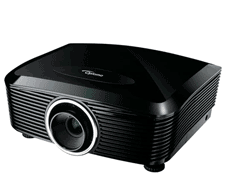
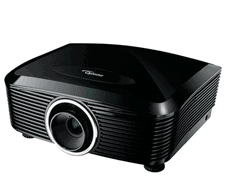
 Announced at last year's CEDIA, Optoma's HD8600 is currently the top-shelf model in the company's custom-installation line. It's loaded with Optoma's most advanced imaging technologies and recently earned the CEA's Mark of Excellence Gold Award for Video Product of the Year. We have not performed a hands-on review of the HD8600, but here is an overview of its features. This 1080p, single-chip DLP projector has a rated brightness of 1,600 ANSI lumens and a rated contrast ratio of 50,000:1. It uses Texas Instrument's DarkChip3 DLP chip and features 10-bit processing, a new color management system, an automatic iris and Optoma's PureEngine image processing technologies--which includes PureMotion2 to reduce film judder. ISF calibration modes are available, and you have a choice of three lens options, for a standard, short or long throw. The HD8600 uses a 280-watt P-VIP lamp and has a rated noise level of 29 decibels in the standard lamp mode.
Additional Resources
• Read more projector reviews from HomeTheaterReview.com.
• Find a projector screen for the HD8600.
In terms of physical setup tools, the HD8600 offers adjustable feet and manual lens-shifting dials. Depending on projector placement, you can get between 30 and 110 percent vertical shift and 5 percent horizontal shift. The standard-throw lens includes 1.25x manual zoom, while the long-throw lens offers 1.5x manual zoom (the short-throw lens has no zoom). All three lenses have a manual focus dial. This projector weighs 19 pounds.
The connection panel includes three HDMI 1.3 inputs, as well as a
single component video, PC, S-video and composite video input. The HDMI
inputs accept both 1080p/60 and 1080p/24 signals. The HD8600 also
sports dual 12-volt triggers, a USB service port, and an RS-232 port
for integration into an advanced control system. The package includes
two remote controls: a primary, fully backlit remote that offers
dedicated input and aspect-ratio access, as well as direct access to
numerous picture controls, and a backup remote with on/off, menu,
source and directional buttons.
The setup menu has a thorough assortment of picture adjustments,
starting with nine image modes (including ISF Day and Night modes that
are accessible by a professional calibrator). Other adjustments
include: six color-temperature presets, plus RGB gain and bias controls
to precisely tweak white balance; an advanced color management system
with the ability to individually adjust each color point; four
adjustable gamma settings; incremental noise reduction; five color
gamuts; two lamp modes; and the ability to engage the auto iris and
manually adjust its range. The PureEngine sub-menu has three controls:
PureDetail is an edge enhancement tool, PureColor affects the picture's
"vividness" and PureMotion2 uses motion interpolation to produce
smoother movement with film sources (low, medium and high options). For
those who don't like the look of motion-interpolated film sources, if
you leave PureMotion2 turned off, the projector will output 24p Blu-ray
at 48Hz, showing each frame two times.
The HD8600 offers four aspect ratios, including a native mode for
viewing the image without any scaling and an LBX mode for viewing
2.35:1 content without black bars (this requires an add-on anamorphic
lens system to view without distortion). There's also a SuperWide zoom
mode that produces a 2.0:1 aspect ratio that allows both 1.78:1 and
2.35:1 movies to be viewed without black bars. You have the option of
adding overscan or using an edge-masking system to hide noise around
the edges of the picture, usually visible with TV content. Vertical
shift and vertical keystone adjustments are also available.
Read about the high points and the low points of the HD8600 on Page 2.
High Points
• The HD8600 has a 1080p resolution and can accept 24p sources.
• PureMotion2 processing allows you to reduce judder for smoother motion in film sources.
• Dual lamp modes allow you to tailor the projector's light output to suit your viewing environment.
• It has three HDMI inputs, as well as 12-volt triggers and an RS-232 port.
• Three lens options are available, as are ISF calibration modes.
• An anamorphic mode is available, if you'd like to mate the projector with an anamorphic lens system.
Low Points
• The zoom, focus and lens-shift controls are manual, not motorized.
• The horizontal lens-shift function is limited.
• The company opted for a 48Hz output mode, instead of 96Hz, with 24p
Blu-ray sources. In general, 96Hz proves to be more effective.
Related Reviews and Content
Compare the Optoma HD8600 against its competition by reading the reviews for the JVC DLA-HD100 1080p 3-chip D-ILA front projector reviewed by reviewed by Jeremy Kipnis and the Sony VPL-VW60 Bravia SXRD 1080p cinema projector reviewed by Andrew Robinson. Learn more about projectors by visiting our All Things Video Projector section.
Conclusion
Much like Epson does with its Pro Cinema versus Home Cinema lines,
Optoma targets different projectors at different markets. The HD8600 is
aimed specifically at the custom-installation market and sold
exclusively through AVAD. In its standard-lens configuration, it has an
MSRP of $7,499 (the cost is $8,499 for the short-throw lens and $8,999
for the long-throw lens), which pits this DLP model against top
performers from companies like JVC and Sony. The HD8600 offers
comparable features and, by all accounts I've seen, more than holds its
own in the performance realm. Its higher light output makes it a good
choice for someone who plans to use a larger-than-average screen in a
dedicated theater environment.
