
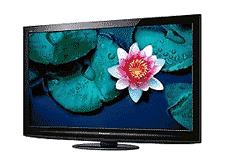
 With all the attention being paid to Panasonic's first 3D-capable TVs (the VT25/VT20 Series), it's easy to overlook the fact that the company has also released a complete suite of 2D models. At the top of the company's 2D lineup sits the G25 Series, which includes four models with screen sizes of 42, 46, 50 and 54 inches. (The G25 Series is virtually identical to the G20 Series, sold exclusively through Best Buy.) The 50-inch TC-P50G25 is a THX-certified, 1080p plasma TV: It features Panasonic's 600Hz Sub-field Drive to improve motion resolution, as well as the new Infinite Black Panel that rejects ambient light and improves black-level performance. Panasonic's VIERA CAST Web platform is available, and you can connect to the network via Ethernet or an optional USB WiFi adapter ($99.95). As with last year's incarnation, VIERA CAST provides access to Amazon VOD, YouTube, Picasa and news/weather information; this year, the service adds Pandora, Twitter, Skype (with the addition of an optional Web camera, $169.95) and (soon) Netflix. This model does not support DLNA media streaming, but an SD card slot and dual USB ports allow for quick, easy playback of music, photo and even HD video files. The TC-P50G25 is EnergyStar 4.0-certified and has an MSRP of $1,499.95
Additional Resources
• Read more plasma HDTV reviews from HomeTheaterReview.com.
Setup and Features
Panasonic hasn't quite kept up with the Joneses in the area of cabinet design. It's not that the TC-P50G25's gloss-black cabinet and rounded, swiveling base are unattractive they're just not as visually distinctive as you'll find elsewhere. With last year's high-end Z1 Series, Panasonic demonstrated that you could offer a super-slim plasma TV, but that design has yet to find its way into other lines. The TC-P50G25 measures 3.5 inches deep and weighs 57.3 pounds without the stand. The remote sports the same basic Panasonic look we've seen for years, but it now includes backlighting for key functions. The layout is generally intuitive.
Four HDMI inputs have become the norm in higher-end lines, but the TC-P50G25 offers just three. However, while other TV manufacturers have moved to a single component video input, Panasonic continues to offer two CV inputs, which is helpful to owners of legacy equipment. The back panel also includes a PC input and one RF input to access the internal ATSC and Clear-QAM tuners. One HDMI input is located on the side panel, where you will also find the SD card slot and dual USB ports that support the addition of the optional WiFi adapter, Web camera, and/or external keyboard. The Ethernet port for VIERA CAST is located around back.
The TC-P50G25 doesn't have quite as many advanced picture controls as you'll find in competing models, but it has more options than we've seen in previous high-end Panasonic panels. As with all THX-certified displays, this one includes a THX picture mode that should (and does) offer the most accurate, natural-looking image out of the box. Unlike LG's new THX-certified TVs, the TC-P50G25 does not have two THX modes--one for cinema and one for a brighter room. It has just the one THX mode, but you do have the ability to fine-tune the image quality in this mode--something LG doesn't let you do. In addition to basic adjustments for color, tint, contrast, brightness and sharpness, the picture setup menu includes five color-temperature presets, a C.A.T.S. function that tailors the TV's picture quality based on the room's ambient light, several forms of noise reduction, a blur reduction function and more. Blur reduction enables Panasonic's 600Hz Sub-field Drive, which creates extra sub-fields to improve motion resolution. The menu also allows you to designate a frame rate for 24p Blu-ray film content: 48Hz or 60Hz.
What you can't do in the THX mode is access the Pro menu that offers advanced controls like white balance (high/low red and blue only), gamma (six presets), black extension, contour emphasis and panel brightness. That's right, this plasma includes something akin to an adjustable backlight, with low, mid and high brightness options. These controls are only accessible in the Custom picture mode. Absent from the basic or pro setup menu is an advanced color-management system that allows you to individually fine-tune each of the six color points, although I'd soon discover that this wasn't a control I really needed.
The TC-P50G25 has five aspect-ratio options: 4:3, Zoom, Full, H-Fill, and Just. The menu includes two HD Size options: Size 1 shows 95 percent of the image, while Size 2 is pixel for pixel for 1080i/1080p content. In last year's THX models, the THX mode was locked in pixel-for-pixel mode, which is fine for Blu-ray but isn't always desirable with broadcast TV, where noise might be visible around the edges. Thankfully, Panasonic has unlocked it in this year's models, so you can adjust the THX mode's screen area just as you can the other picture modes.
On the audio side, the TC-P50G25 includes bass, treble and balance controls, as well as an advanced menu that includes a basic surround mode, a bass boost function, and A.I. sound and volume leveler functions to help minimize volume discrepancies across channels and inputs. This TV does not include an advanced volume-leveling mode from a company like Dolby or SRS.
In the general setup menu, you'll find Network setup options (which include the ability to perform firmware updates), as well as Anti Image Retention options: a pixel orbiter that periodically shifts the image, a scrolling bar to help counteract any image retention that may occur and the ability to adjust the color of 4:3 sidebars. The Eco menu only includes the ability to turn off the TV if it has received no signal or shown no activity for a designated time period.
The remote's VIERA CAST button launches Panasonic's Web platform, which offers a clean, easy-to-navigate interface. The source you're currently watching continues to play in the center of the screen, surrounded by VIERA CAST options like Pandora, Amazon VOD, Skype, etc. This year's design allows you to customize the interface, rearranging the various options or deleting them from view. Panasonic previously announced that Netflix's streaming video-on-demand service would be added in July; as I conclude this review on August 2nd, Netflix was still not available through the most recent firmware update (v2.050).
Performance
As I like to do with every THX-certified display I review, I began by simply switching the TC-P50G25 to the THX picture mode and making no further adjustments. In this particular case, a houseguest arrived just as I was beginning my review, so I wound up leaving the Panasonic un-calibrated, in the THX mode, for two weeks. During that time, we watched a lot of TV, as well as two movies--Terminator: Salvation on Blu-ray (Warner Home Entertainment) and Shutter Island on DVD (Paramount Home Video). Perhaps the highest compliment I can pay this Panasonic TV is that I was able to simply sit back and enjoy its performance with everything I watched, not once being distracted by any obvious performance issue. Both of those films are visually dense, with a lot of dark, complexly lit scenes that would easily reveal flaws in lesser performers. However, the TC-P50G25 handled them extremely well, serving up good blacks, rich contrast, excellent black detail, and natural color. The TC-P50G25 allowed me to turn off my video-reviewer mode and just get lost in the movie experience, and that's exactly what you want in a TV.
Of course, I couldn't very well leave my video-reviewer mode turned off for long. As soon as my houseguest left, it was time to bust out my standard arsenal of test discs and dig deeper into the TC-P50G25's abilities.
Continue reading about the TC-P50G25's performance on Page 2.
I still had the LG 47LE8500 ($2,699.99) on hand, which is also THX-certified and one of the best-looking LCDs I've reviewed to date; so, I spent a fair amount of time comparing the two, especially their THX modes. The first thing I noticed was the TC-P50G25's excellent detail with high-definition sources; it did a better job rendering the finest details, whereas the LG's picture looked a bit soft (this was one of my criticisms of the LG's THX mode, which can't be adjusted; the picture benefits from switching to the Expert mode and calibrating the image). The color points were pretty close between the two: Both TVs offer natural-looking colors that don't veer far from accurate. However, their color temperatures were noticeably different. The Panasonic's default Warm2 setting has a greenish-yellow tint--a trait I've also seen on Samsung and Toshiba TVs. This tint gives the picture a warmer, more inviting quality that I think videophiles prefer, and it seems to help cut down on the appearance of red in skintones. But, when comparing the Panasonic side by side with the LG, which runs slightly cool but doesn't have the greenish-yellow tint, whites actually don't look as accurate. The LG's whites really looked white, while the Panasonic's whites had too much green. Because I could adjust the Panasonic's THX settings, I was able to try the Warm1 mode instead, which was a little cooler overall but removed the excess green-yellow tint. So, even though you can't do a full-scale white-balance adjustment in the THX mode, you do have some flexibility to adjust the color temperature to find a palette that you prefer. (As I mentioned above, you can adjust white balance in the Custom mode, or you can hire a professional calibrator to access the service menu and do a full calibration of the THX mode.)
The 47LE8500 uses a full-array LED backlighting system with local dimming, which generally offers the deepest blacks you'll find in the LCD realm (and adds to the cost). Comparing black levels in scenes from Pirates of the Caribbean: The Curse of the Black Pearl (Buena Vista Home Entertainment), Flags of Our Fathers (Paramount Home Video) and Casino Royale (Sony Pictures Home Entertainment), the LG produced a significantly deeper shade of black in sidebars and all-black portions of the image, where it has the benefit of being able to turn off its LEDs completely. The LG also had an edge in overall contrast; but, when you consider the price disparity between these two TVs, the Panasonic more than held its own--producing a respectably deep black that resulted in a rich, dimensional image, regardless of whether the room was bright or dark. The plasma also held an advantage in its ability to render the finest black details. In certain places where the LG went ahead and turned off its LEDs to produce a deeper black, the Panasonic was still able to reveal subtle black details. More so, because a plasma pixel generates its own light, its black level and shading can be more precise; it does not produce the glow or halo effect around edges that you can see in a local-dimming full-array LED model. (Admittedly, that glowing effect is quite subtle in the LG; but, when compared to a plasma that doesn't do it at all, you can see it.) And, of course, plasma has a huge advantage in the viewing-angle department: Black level and overall image saturation remain the same regardless of where you sit in the room.
One complaint about last year's Panasonic THX-certified models was that the THX mode was too dim. I personally didn't find this to be an issue, but the company has addressed it nonetheless. This year's THX mode is clearly brighter, which improves image saturation in a brighter room. As I said above, in the Custom picture mode, you can actually adjust panel brightness. The High setting really cranks it up but adds a ton of noise in the process, so I suggest you avoid it. The Mid setting offers a solid balance, increasing panel brightness without introducing extraneous noise. The image looks a little flatter and more washed out than the THX mode, but it might be a good option if you have an especially bright room and want to set up a picture mode specifically for daytime viewing. Speaking of which, Panasonic's new Infinite Black Panel has been redesigned to do a better job of rejecting ambient light to cut down on glass reflections and improve black-level performance in a brighter viewing environment, and it succeeds. With my room lights turned up or the blinds open during the day, blacks looked quite dark, and this plasma produced a lot less glare than the LG's reflective screen.
In the processing arena, the TC-P50G25's picture setup menu includes an option for 3:2 Pulldown, with On, Off and Auto options. This setting allows the TV to recognize the process that converts 24-frames-per-second film to the TV's 60Hz output. Strangely enough, at the default Auto setting, the TC-P50G25 failed the 1080i film test on the HD HQV Benchmark Blu-ray disc (Silicon Optix), and it failed my real-world demo from the Mission Impossible III BD (Paramount Home Video). When I switched to the On setting, it passed these tests, although it was still a bit slow to lock on to the signal. Sometimes the TV cleanly rendered the staircase in chapter eight of MI3; other times, it produced some moiré at the start of the scene. With 1080i television signals, I did not notice any significant deinterlacing artifacts. When you feed the TC-P50G25 a 1080p/24 film signal from a Blu-ray player, you can choose between the standard 60Hz output, which adds 3:2 and creates judder, or 48Hz, which uses a slightly smoother 2:2 process but creates flicker. I found the flickering effect to be much less pronounced than it was in the G10 model, but it's still noticeable, especially in brighter scenes. Since I'm not really bothered by film judder, I stuck with 60Hz output, but I would prefer a 96Hz option (4:4 pulldown).
I find it odd that the blur reduction function is turned off by default, at least in the THX mode. Unlike many LCD 120Hz and 240Hz modes, this function does not seem to alter the quality of motion in any meaningful way, and my tests showed that it does improve motion resolution. Using test patterns from the FPD Benchmark BD, I compared the Panasonic's motion resolution with that of the LG, which has excellent motion resolution when its TruMotion 240Hz technology is enabled. With blur reduction turned off, the TC-P50G25 retained detail in the HD 720 test pattern but not the HD 1080 pattern. Turning the function on cleaned up the pattern and made lines visible at HD 1080 (although they still weren't as pristine as the LG's). I see no reason why you shouldn't use this function all the time, just to ensure that you're getting the best detail in faster-moving scenes.
The Downside
Standard-definition content isn't exactly the TC-P50G25's strongest suit. I saw nothing overtly problematic when I watched the Shutter Island DVD, so I wouldn't characterize the SD performance as poor. However, with my usual 480i tests, the TC-P50G25 simply didn't perform as well as other TVs I've recently tested. In general, SD images looked somewhat soft, and the processor was slow to pick up the 3:2 cadence with 480i DVDs. I saw some artifacts in the opening of the Coliseum flyover in chapter 12 of Gladiator (DreamWorks Home Entertainment). The picture had a bit more noise than the LG (both with SD and HD content), but I found that engaging the noise reduction successfully cut down on background noise without softening the picture.
Most of the VIERA CAST services performed as expected, but I had a lot of trouble with the Amazon Video-on-Demand service. With two different movies--Hot Tub Time Machine in SD and Sherlock Holmes in HD--the video often failed to load or stopped during playback, forcing me to re-initiate playback. I assume this was an issue with Amazon's service, since the company sent me an apology and a credit without me even having to complain--still, it certainly made me wish that the Netflix option were available.
Beyond the 48Hz option for 24p sources, the TC-P50G25 does not offer any type of de-judder mode for film sources. I personally don't consider this to be a low point because I don't like the way these "smooth" modes affect the quality of film motion; however, some people love that super-smooth, video-like look. For them, the absence of this feature is a drawback.
Finally, there's the issue of black-level retention. For those of you who may not be familiar with this development, CNET has reported on complaints that the excellent black levels in last year's Panasonic plasmas diminished suddenly and noticeably, which affects the picture's overall contrast. Panasonic acknowledged the problem but said that, in new 2010 models, the black-level change will be more gradual over time and that it levels out at a point that still yields excellent picture quality. It seems like every flat-panel technology now comes with some type of black-level caveat, be it the glowing effect of full-array LED, the uniformity issues of edge-lit LED, or this legitimate concern over rising black levels in a plasma. (I have not heard reports of this issue with Samsung or LG plasmas, but they don't have Panasonic's market share in the plasma space.) The question becomes, which caveat are you most willing to accept in your flat-panel TV? I'm not going to downgrade my performance review of this plasma based on something that may or may not happen, but I do feel compelled to mention it. (FYI: CNET is tracking the black-level performance of its G25 review sample, so they can offer firm numbers as the year progresses.)
Conclusion
With the TC-P50G25, Panasonic once again offers a TV that is just easy to like--one that strikes a great balance between cost and performance. You also get a nice selection of features, including video-on-demand, Skype, SD card and USB media playback, and optional WiFi connectivity. A well-executed THX mode allows the TC-P50G25 to serve up a very attractive HD picture with little to no effort, which makes this an excellent choice for someone who just wants to enjoy a great TV-watching experience without delving too deep into the technology behind it all.
Additional Resources
• Read more plasma HDTV reviews from HomeTheaterReview.com.
• Find great plasma news from HDTVetc.com.
• Buy the TC-P50G25 from Panasonic.
