
 It's time to admit, in light of the arrival of SACD and DVD-Audio, that CD playback hasn't been all that bad for the last, oh, decade and a bit. Who can possibly fault the sounds made by pedigreed players from Wadia, Meridian, CAL, Theta, Mark Levinson and the like? Ever since the arrival(s) of late-1980s milestones like the Marantz CD-12/DA-12 at the high end, and the Ken Ishiwata-tweaked Marantzes at the other end, there have been CD players at nearly every price point that deliver sound quality which is, at the very worst, acceptable. Yes, vinyl still massacres CD on every level bar convenience, but the LP's role in audio has been, for 15 years at least, akin to that of Morgan in the world of sports cars: best left to a hardier breed.
If you accept, then, that CD is the status quo whether vinyl addicts like it or not, and that halfway decent CD players are a dime a dozen, and that the landscape is about to change anyway thanks to two new formats, what is the potential for a new CD player at the £999 mark? That it has a Quad badge on it isn't quite the same magnet as it was in say, 1959, when there were fewer competitors or alternatives. That it sounds terrific or offers nifty features or looks cool - any one of these isn't enough on its own, either. But imagine if all those qualities were contained in one compact chassis. If possible, then, hey, presto, you have the same kind of appeal which allowed the Quad 33 pre-amp to sell well over 100,000 units.
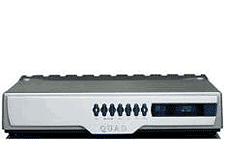
Called the 99 CD-P to distinguish it from the 'normal' 99 Compact Disc Player at £649, Quad's new player has little in common with the less expensive model beyond the cast aluminium case. For openers, the 99 CD-P has an onboard power supply and both variable and fixed line level outputs which allow it to serve as a true stand-alone player; the plain vanilla 99 works only with the 99 system and feeds its output through the Quadlink connection. Moreover, the 99 used an 18-bit Delta Sigma converter and a single laser transport. For the 99 CD-P, the ante has been upped with the latest 24/192 upsampling Crystal DAC and a Philips three-laser transport for better all-round performance. On top of that, designer Jan Ertner cooked up proprietary filtering for the 99 CD-P, too. So, before we go any further, note that the extra £350 gets you more than a feature which is best described as the 99 CD-P's 'party trick': full pre-amplifier functionality.
Within the tiny dimensions of 80x321x310mm (HWD) is a CD player AND a digital pre-amp accepting six digital sources via three co-axial and three TOSLINK optical inputs. Thus, the CD-P has a very busy back panel indeed. Reading it from left to right across the back, there's an IEC mains input, main power on/off via a rocker, phonos for fixed or variable output (the latter enabling use as a pre-amp into any power amp), connectors for full accessibility to an all-Quad system, the digital inputs, and a TOSLINK optical digital output. As it was not Quad's intention to make an alternative to the 99 Pre-Amplifier (see box: The Quad System), the 99 CD-P lacks any analogue inputs. Be glad they left them off: this would have increased the burden in terms of both cost and real estate, thus robbing the 99 CD-P of its chic demeanour and bargain pricing.
At the front, the CD-P's left half is filled by the CD tray, while the right half contains four buttons for power on from stand-by, next/previous tracks, play/stop and open close, and a display reading track number, time in various forms and information for programming. All of this is accomplished through the 31-button remote, which also provides source, volume and mute for the pre-amp functions and display off for those who prefer an absence of flickering digits. My only operational complaint was the need to switch the unit out of standby with the remote's power button; I'm used to players which leave stand-by just by pressing play.
Set-up and the learning curve were brief and painless: quite simply, everything worked, and the owner's manual was written by someone who didn't assume that every customer understood MS-DOS. I tried the 99 CD-P from both its fixed and variable outputs with the Musical Fidelity Tri-Vista 300 driving Wilson WATT Puppy System 6 and via the variable outputs into the Quad 909 power amplifier, feeding the Quad 12L speakers. Wires came from Chord, DiMarzio, Kimber and Transparent, the 99 CD-P being especially partial to a pair of Transparent cables which cost more - alas - than the player itself. I could detect no qualitative difference between the fixed and variable outputs, so I would suggest that the potentiometer is of very high quality. In other words, you mustn't feel that using the 99 CD-P's pre-amp capability is a compromise. If anything, its 'short path' nature (again, see the sidebar) more than compensates for the presence of an on-board volume control.
Because this is being written during the months leading up to Christmas (which nowadays means 'anytime after August 31st...'), I have been wallowing in the season's 'best ofs', with the Rolling Stones' 40 Licks and Elvis Presley's 30 No. 1 Hits, both of which I heartily recommend even if you own everything on them. The mastering seems to be of a higher standard than that which has gone before, which may be one of the reasons why I'm loosening up about CD in general. (This is not the place to debate the 'burning' issues of SACD and DVD-A.)
Every component inserted into a pre-existing system exhibits some characteristic to distinguish it from whatever preceded it. (Unless it's so neutral and therefore perfect that it has no signature.) The Quad 99 CD-P is no exception. Blessedly, as the 99 CD-P was something I
Take, for example, 'Are You Lonesome Tonight?' from, one of the King's schmaltzier affairs. Elvis stands in the centre (OK, I almost wrote 'dead centre' but resisted), an acoustic guitar to the left, the Jordanaires to the right. Now I have no idea where they were standing in the studio, how many takes made up this version - for all I know, it's either a real-time, one-take masterpiece or an early example of studio surgery. But whichever is the truth, it's still a studio recording. Through the CD-P, it sounded 'in the room', with real walls, a floor, a ceiling. And no minor digital nasties distinguished it from the vinyl.
Ditto my all-time fave, 'Can't Help Falling In Love' - similar layout, similar textures. But the way the Quad handled the Hawaiian guitar...liquidity? You bet your stylus balance. The space around the piano, the mesh of the Jordanaires' voices - the Quad sounds as lush and fluid as it needs to be. And by that, I mean that there's no added, tube-ish warmth, however much I love the lie that implies. The 99 CD-P manages to be clean and analytical while dealing with warmth and emotion, such that the former doesn't negate the latter. Even the tambourine on 'Wooden Heart' - no more splash than necessary. The accordion is reedy, the oom-pah feel just right. And old El's German accent wasn't all that bad, either.
In less abstract areas, the Quad really pushes my buttons. Its bass is simply prodigious: fast, controlled, tight, but never overdamped, as exemplified by the openings to both Elvis' 'Good Luck Charm' and the Rolling Stones' 'Honky Tonk Women'. If you're of the temperament (and I most certainly am) which considers most digital bass to be so unnaturally constipated that it makes your ears ache, you will find blessed relief in the wee Quad. It never oppresses. Instead, it swings, it flows, it's deliriously full and juicy but it never gets loose or sloppy. If it were part of someone's anatomy, then it would be Nigella's butt. Check out Elvis' loping 'She's Not You' and (again) 'Good Luck Charm' to hear this to best effect. While you're there, wallow as well in the backing vocals.
Read more on page 2
Using these tracks as evidence, there ain't a whole helluva lot happened sonically in the 40 years since he laid down those tracks.
This player can do 'trashy' (the drum sound on 'Jailhouse Rock'), classy (Ella's orchestral backing on 'Manhattan'), 'sweet' (Alison Krauss no matter what she sings), grandiose (J. Geils Band's 'I Can't Believe You'). It is immune to genre, it will let you hear the difference between silver and gold CDs, it allows you to listen to five or six discs in a row without fatigue. It is simply a gem.
OK, so I won't be dumping the Marantz CD-12, which still has slightly greater 'command' and an even larger soundstage, but that player is a rara avis of no fixed price and availability. High-end oddities aside, Quad's latest is the BEST-SOUNDING sub- 1000 player I've heard since the Musical Fidelity X-Ray. And that's a player I use every day without complaint. In the wings is Unison Research's tube-hybrid Unico CD player, which, if it matches the genius of the Unico integrated amp, may give the 99 CD-P a run for the money. But the 99 CD-P's ace-up-the-sleeve, a six-input digital pre-amp, makes Quad's offering genuinely unique. And with a sticker price of 999, it's definitely my CD Player of the Year. And it's only January.
Quad 0845 458 0011
SIDEBAR: THE QUAD SYSTEM
Ordinarily, as CD players are line-level-output devices, manufacturers deliver the players on their own for review. They assume that the reviewer will drop it into a reference set-up, regardless of make, and leave it at that. This time, however, it played out differently because the 99 CD-P contains what is effectively a
As Quad's Dave Patching told us, 'We are simply adhering to Quad philosophy - we wanted to create, for those who appreciate the gains, the shortest signal path possible. So we took the 99 Pre-Amplifier's potentiometer and segued it into the CD-P, taking the opportunity to add the convenience of six digital inputs. This in turn allows the CD-P to serve as an outboard DAC for customers with other digital sources. And they are on the increase.' Think DAB, MiniDisc, satellite TV, whatever emanates from a PC's or Mac's soundcard, Playstations and X-Boxes and more.
To show the ability of the 99 CD-P in an all-Quad system, the company provided the now-familiar 909 power amplifier and the new, but already-award-winning 12L loudspeaker. To say that the combination dazzled me is understatement. The amplifier itself is one of hi-fi's best-kept secrets, a gift at 899 for a robust and bomb-proof 140W/channel stereo unit. Why I don't know, but it reminded me more of the classic 303 than any of the company's later models: ridiculously powerful for its size, impeccably mannered, built like a vault, styled to raise a smile. It's both subtle and funky, able to deal with delicate acoustical works or to rock hard when fed the likes of Nickelback. Could I forsake all others and live with it? No sweat - just as I used a 303 daily for six years without suffering withdrawal symptoms.
But the real surprise was the 12L. Those of long memory know that I loved the 10L, Quad's first-ever box-type loudspeaker, a Spendor-made quasi-LS3/5A challenger of wondrous ability. The Steve Hewlett-designed 12L is even better: easier to drive, more forceful, bigger sounding. (Hewlett is, of course, the genius responsible for the Wharfedale Diamond 8.1.) Hell, it's even less expensive at 499 and much prettier looking, with a veneer so rich that it recalls the kind of furniture I could never afford. And it simply adores the 909. A two-way design, it contains a 25mm cloth dome tweeter and a 6.5in Kevlar woofer crossing over at 2.2kHz, in an enclosure measuring 345x205x253mm (HWD). Impedance is a safe 6 ohms, and the power rating is 30-140W - obvious 909 territory.
This speaker sings. It stated its purpose within five seconds of hearing 'Honky Tonk Women' off the Rolling Stones' 40 Licks, confirmed its greatness with Alison Krauss, and won my heart with two complete plays in a row of Elvis' 30 hits. The amplifier served it to perfection, never clipping, never relinquishing its hold on the bass, never aggravating the tweeter. Clearly, Quad's design team puts total compatibility high on its list of priorities. In this case, one might suspect that more 12Ls would be driven by the less costly, less powerful 99 stereo amplifier, but trust me: the added benefits of the 909 are exploited to the fullest.
No, I'm not going to tell you that this package - 99 CD-P, 909 and 12L - is the very best way to spend 2400. But the system IS a no-brainer in terms of it being able to make, straight out of the box, the sort of sounds that would be impossible to fault in a situation where diminutive components are preferred, where ease of use is one of the customer's Top 10 requirements, where reliability, longevity and assured synergy are
If for no other reason than nostalgia - this system is the closest Quad has come since Peter Walker's retirement to a return to the very values which made the company the UK's most important-ever brand - I just love it. What I'd love even more is for Quad to issue the 99 CD-P and the 909 in a limited edition in the same muted champagne gold colour as the original 303....
