

Having only ever seen (and heard) Simaudio's products at foreign hi-fi shows, it was with much glee that I responded to the news that there was now a solid UK importer. The equipment always struck me as intelligent, non-political and wholly desirable. So I jumped when the folks at Red Line A/V Distribution came up with just the model for me to try, given my recent penchant for specialist integrated amplifiers. As hoped, the Canadian company's Moon i-5 integrated not only fit the bill, it also differed enough to keep up the winning streak of interesting variations on the theme.
Additional Resources
• Read audiophile power amp reviews from the likes of Krell, Mark Levinson, Audio Research, Linn, Naim, VAC, VTL, NuForce, Pass Labs and many others here.
• Read about tubes on the Audiophile blog, AudiophileReview.com.
• Want to read audiophile stereo preamp reviews? We have dozens from brands like ARC, Krell, Classé and many more.
• In the market for audiophile loudspeakers? Here are over 100 reviews from brands like Wilson Audio, THIEL, MartinLogan, Bowers & Wilkins, PSB, Vandersten, Magnepan and many more.
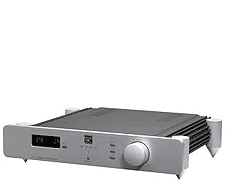
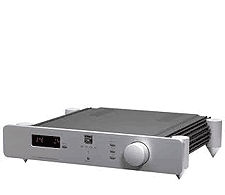
On the other hand, you can only do so much with a formula of single box containing a stereo pre-amp/stereo power amp, aided in most cases by a remote control. Thus, the i-5, fresh out of the box, reminded me of the Pink Triangle Integral because of its dense compactness. The clean fascia made me think Gryphon. And although there's no Wadia integrated amp in this survey, the cylinders at the corners, terminating in points, recalled that brand's CD players. Around the sides, the horizontal, arc'd fins brought to mind Alchemist and its progeny. But full marks to Simaudio: instead of looking like a collage of modern design features, like bad-boy Sid's monstrosities in Toy Story, it emerges with its own look, and the rest of the catalogue reflects this. Hell, the Moon I-5's front panel is virtually identical to that of the company's pre-amps bar the model name.
Within the jam-packed enclosure - genuinely shelf-friendly at only 17x4x15in (WHD) - is a five-input J-FET/MOSFET line stage driving a 'partial' dual-mono power amp. Simaudio believes in very short signal paths, so the i-5's is a mere 15 inches from the solid, gold-plated input sockets to the magnificent WBT 0744 output binding posts (a KK all-time fave!!!). The company believes that such a short signal route eliminates all manner of interference, while producing 'a sonically faster transient response.' Simaudio also maintains a preference for close matching of the high quality electronic components (the interior looks like a showcase for 'designer' brands) and a symmetrical circuit design.
Arch modernity and a fine distancing from hair-shirt traditionalism come through the use of a Crystal microprocessor in the gain stage, acting 'as a shunt-to-ground applying more or less impedance against the input signal.' This is said to provide gain control which doesn't degrade sonically, regardless of the selected level. Additionally, the preamplifier section is '[de]void of carbon-based parts and capacitors, both of which adversely affect the musical signal by introducing colorations and a degree of inaccuracy.'
In the power amp section, the active devices are two bipolars per channel, for 70W per side into 8 ohms. The power supply boasts 'very low resonance characteristics' and features a proprietary-design transformer to provide better current stability for improved precision and control of the musical signal. The company is also of the feedback-is-bad school, so there is no overall feedback circuitry, said to yield 'real-time amplification, more tonally accurate musical reproduction, virtually non-existent intermodulation distortion and the elimination of common phase errors resulting from feedback.'
Although clearly a product of the modern era, with a clear nod to convenience and a possible role in a custom-installed system, the i-5's front panel is truly minimalist in the Sad Audiophile Masochist manner. A large display on the left shows level in large red digits, and also helps when the user sets the balance; the latter is accessible only via remote. To the display's right is a button to switch off the illumination. Dead centre is a standby-button below an LED; the i-5 was designed to be powered on at all times for optimal performance, so the primary on/off is a rocker button at the rear. Even left on at all times and working hard, the unit never scorches the user's fingers; Simaudio insists that this low operating temperature will lead to a longer-than-normal life expectancy.
To the right of the standby switch are three buttons in a vertical array (tape monitor select, mute and input select), followed by a rotary volume control. That's it. Every operation is mirrored on the deliciously hefty, all-aluminium, custom-made remote. It boasts only seven buttons which provide you with volume, mute, power on/off, source select (scrolling through the sources) and the aforementioned balance control via left/right arrows. The remote is a must, but - curiously - it's not included in the price. But see below...
Spec-wise, the Moon i-5 is impressive enough to dazzle numbers junkies, and in keeping with modern components, they suggest a quiet, powerful operator. Signal-to-noise ratio is a wide 97dB, THD is 0.1 percent, while IM distortion is merely listed as 'unmeasurable'. The damping factor is an impressive 200, while overall gain is 30dB. Bandwidth? 10Hz-70kHz, +0/-3dB. All-in-all, no anomalies, nothing about which to be concerned.
In the company of the other amplifiers in this informal survey, the i-5 features somewhere in the middle. It is neither dirt-cheap nor hideously expensive, neither 'boastfully' robust nor S.E.T.-weedy. Its real 70W, or 110W into 4 ohms, led me directly to the 4 ohms or less Wilson WATT Puppy System 6, which presented no problems; neither did the similarly spec'd Sonus Faber Cremona. Both, however offer 90db or better sensitivity, so I also used the hungrier Wharfedale Diamond 8.1s and a quick burst of LS3/5A. Sources included the Marantz CD12/DA12 and - as didn't receive the version of the i-5 with phono stage - the Lyra/SME 10 package and Garrard 401/Decca International/London Jubilee through a Musical Fidelity X-LP.
First things first: the Moon doesn't give a toss about cables, much to my delight, and it cared little which of my mains rings fed it juice. This immediately suggested a design of close tolerances, robustness, immunity to external forces, a sturdy power supply and even a disdain for audiophilic tendencies - despite the high designer-component content within. It also made me ponder the following: given that the Moon is slightly lower-powered than similarly-priced integrateds, most of which boast 100W/ch or 200W/ch output, maybe, just maybe someone at Simaudio secretly adheres to the aged music lover's notion that the sweetest-sounding amplifiers of all tend to yield only double-digit wattages. (Yes, I still dream about the old Audio Research D-70...)
And sweet it is, notwithstanding its purely solid-state snap, its taut bass and a sonic cleanliness just a hair away from sounding too hygienic. Whatever I may have implied before about the melange of design features, there's clear
At every point in the frequency spectrum, there's an all-pervading sense of complete control, masterfully applied without suggesting a restriction of dynamics. Controlling - no, make that 'limiting' an amp's behaviour at the frequency extremes is the easiest way to make it behave, but it also castrates the music at both ends. (Ouch...) However well-mannered the Simaudio sounds no matter what abuse you may apply, it never seems restricted - it just keeps on singing within the bounds of a serious 70-watter. In my case, I never managed to make it clip; I backed off before it did.
With the above in mind, and assuming that the sonic etiquette might be reflected in the unit's operational behaviour, I can understand why the i-5 could find an audience beyond braver audiophiles who are known for their lack of caution - who else would buy some of the near-lethal confections beloved of the SET crowd? The amplifier never betrayed any glitches, never failed, never shut down. Which means that I never triggered the red tell-tale to indicate something was amiss. I don't want this to haunt me, but...I would not be averse to recommending the Moon to a customer known for paranoia about reliability.
So far, so Pink Integral, but with slightly less overall dynamic impact, yet greater front-to-back stage depth. So far, so Gryphon Callisto, but with slightly less bottom-end kick. What the Moon delivered, however, that gave it its own claim to greatness, was an airy, breezy openness which manifested itself best with the new Chesky CD of the Persuasions singing Beatles classics. This is an a cappella release recorded with all the care the Chesky musters, rich and silky and - on the best systems - in the room. This amp caresses the voices, and spreads them across the soundstage. It soon emerged that the Simaudio is more at home with the refined and the delicate than the raucous.
Not that that stopped me. Corey Harris's 'High Fever Blues' off Fish Ain't Bitin' (Alligator), with its sharp bursts of New Orleans-grade tuba and trombone saw the Moon rise to the occasion - fast, sharp and requisitely raspy, but with all the bloom needed to convey the tuba's weight. On top, a gravely voice, plus some Dobro. This is a heady mix which the Moon both separated and blended with the skill of Thai chef balancing coconut milk and chilli.
All this for 2500? There are lot of rivals in the marketplace, not least being UK-made pre-power combinations, all manner of S.E.T. integrateds of negligible output - hell, in this day and age, the figure even includes some very tasty A/V receivers yielding better than 100Wx5. But the Simaudio Moon i-5 has - build quality and functionality aside - little to do with crackpot, fringe, A/V or other disciplines. It is, for my money, a sane solution for those who want painless stereo.
Which reminds me: because the 2500 price point has psychological importance, and because the distributor is watching the margins, the remote is an optional extra. Daft, I know, but that's commerce. But knowing what the distributor is charging the retailer for the remote, I would posit that any shop NOT throwing it in for free would be the kind of store I would not expect to survive long into the 21st Century.
Quite where the Simaudio Moon i-5 will end up in my (eventual) final tally, I don't know. But away from the integrated pack, it emerges as something of a little miracle. How so? Because it juggles sonic excellence with non-masochistic functionality, and audiophile credibility with confidence-inspiring build quality. Conceptually, its main rivals are the dearer Pink Triangle, Krell and Gryphon offerings, but likely candidates for ownership may well be seduced by that irresistible price tag.
Additional Resources
• Read audiophile power amp reviews from the likes of Krell, Mark Levinson, Audio Research, Linn, Naim, VAC, VTL, NuForce, Pass Labs and many others here.
• Read about tubes on the Audiophile blog, AudiophileReview.com.
• Want to read audiophile stereo preamp reviews? We have dozens from brands like ARC, Krell, Classé and many more.
• In the market for audiophile loudspeakers? Here are over 100 reviews from brands like Wilson Audio, THIEL, MartinLogan, Bowers & Wilkins, PSB, Vandersten, Magnepan and many more.
