
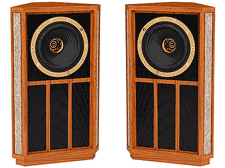
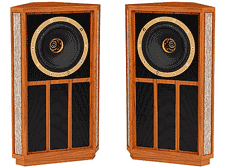

There it was, all creamy-coloured grille and 1950s-look woodwork. It was photographed against a white background, another model in the Tannoy Prestige series of classic coaxial speakers. Then I clicked opened the second image. Only this time, it was sitting on a table. What the f-?!!? It couldn't be much more than a foot high! Why would Tannoy produce a scale model of the 1954 Guy R. Fountain Autograph? I mean, I'd seen cute, miniature point-of-sale material before, including a Quad ESL the size of a paperback novel, and a Magnepan panel not much bigger than an LP sleeve. But they didn't send out press releases.
Additional Resources
• Read more floorstanding speaker reviews from HomeTheaterReview.com.
• Find a subwoofer to integrate with the Autograph.
Nuh-uh: this was a real loudspeaker. A genuine, Tannoy Dual Concentric driver, in a pointed-back cabinet ... but with dimensions of only 13 9/16in tall and a footprint of 8 1/4in wide by 5 1/8in deep - not much larger than an LS3/5A. There were few precedents I could think of other than the 1990s Minox reissues of classic Leica and Contax cameras - 1/3rd scale reductions - that actually worked with the film for Minox's 'spy' cameras. They, too, were gorgeous and covetable. But the Tannoy Autograph Mini isn't just for collectors with a penchant for miniaturisation. No, the Autograph Mini is a real-world speaker that just happens to look like it was stolen from a Lilliputian listening room.
Tannoy describes the Autograph Mini as 'a hugely scaled-down but authentic version of a loudspeaker that was famous throughout the audio world fifty years ago. Reduced to a fraction of the size of the immense and revered original Tannoy Autograph, this exquisite replica is the ultimate modern retro audio product.' I second that. Even if you don't need a pair, you'll want these if you're of the vintage audio collector/Tannoy Fetishist mien. They'll tug at your heartstrings, like a cute little kitten. And that lust will affect a few gazillion audiophiles in Japan. With their limited room size, the world's leading Tannoy wannabees, from Kagoshima to Sapporo, must be staining their futons.
It's as if CNC and MDF never sullied the art of speaker cabinet making. The cabinet build and finish ooze the sort of craftsmanship that marked vintage Tannoys, though I wouldn't be surprised if the enclosures were made in China. Even at £1250 or so per pair, the woodwork seems too expensive for the price tag. And inside is no crappy $2-per-unit driver but a genuine, bona fide Dual Concentric; as the literature puts it so cogently, 'the unique engineering statement that makes this speaker a "real" Tannoy.'
Because Tannoy never stopped making Dual Concentrics, and because so much has happened in terms of materials, the quality of sources and amplification, listening habits and other determinants since the days of Mr. Fountain, the new 4in unit is not a pint-sized surrogate of a Red or a Gold. It doesn't have Alnico magnets or cones made from recycled Penguin paperbacks. We're beyond mere nostalgia, and recent Tannoy Dual Concentrics have been marvellous. (Oh, to have the space for the Churchills!) But, for the record, yes, this is the smallest Dual Concentric ever manufactured.
Size is the only difference, for Tannoy wouldn't compromise on anything else. It's built upon a heavy cast alloy frame, containing a 'multi-fibre paper pulp' cone to cover midrange and bass. Tannoy regards the material as 'traditional but high tech' and able to ensure 'subtlety with stunning detail and expansive imaging.' They're not kidding: The most immediate impression you'll get of the Mini, especially if you go into the room blindfolded, is that of a huge speaker, for both scale and bass delivery. The new Tannoy is 'mini' in name and dimensions only.
What differentiates it most from Dual Concentrics of yore is the titanium domed high frequency compression horn driver, a development of Tannoy's extensive work with super-tweeters. In fact, Tannoy's Tim Lount told me that I would find the company's add-on super-tweeter superfluous, and he was 100 percent correct: if anything, the Autograph Mini has an abundance of treble energy. It is breathtakingly fast and crisp, with the sort of attack that will having you pulling out Alvin Lee LPs to test their speed with his guitar licks. And what it does for trumpet ... wow!
As with all Dual Concentrics, the tweeter is positioned on precisely the same axis as the bass section. It's fitted with a neodymium magnet system, also unavailable to GRF way back when, and is said to deliver a smooth response up to an 'incredible' 54kHz. Suffice it to say, the Mini never sounds dull. 99.99% high purity van den Hul silver cable is used to wire the tweeter to the system's 'minimalist' crossover network, which features audiophile-grade ingredients, including low-loss inductors and specially-damped audio-grade capacitors. At the back are solid, gilded, multi-way binding posts.
High-density birch ply of 10mm and 13mm thicknesses with hardwood veneers and solid hardwood mouldings make up the aforementioned, hand-finished enclosure, and the Mini conveys an aura of fine furniture. This is not a speaker you'd want to hide. However, Tannoy is mooting a version of the Mini in contemporary trappings, with identical performance and dimensions, for the sort of cold, heartless, glass'n'chrome 'lofts' beloved of those who only read fashion mags and still listen to Sade.
For matte grey or cream or whatever constitutes this year's 'black', they will be sacrificing the authentic oatmeal-coloured grille, set into a wooden frame held in place by magnets. Those who go retro will be torn between playing the speaker without the grille - to see that nifty driver and the design fillips recalling the original's baffle - or to leave the grille in place, which tames the treble by a tiny amount.
What the Autograph Mini cannot do is be positioned in a corner like its bigger granddaddy. That's because the size and shape demanded a rear port, so the Mini ought to be sited away from walls, either on stands or shelves. I used the 24in tall IF stands, optimised for LS3/5As, and the top plate's size was ideal. [Note: There seems to be some difficulty at present acquiring IF stands, so I would suggest any stand suitable for LS3/5A-sized speakers, including Partington Dreadnaughts, Foundations if you have a pair, etc.]
Read more about the Autograph on Page 2.
Then again, why stuff it in a corner when it has adequate bass? OK,
so a switch to a true full range design like the MartinLogan Vantage
reveals the Mini's limitations, but trust me: at no point will you
mistake this for anything smaller than a sealed two-way with an 8in
driver. It has almost enough weight and extension to convey the mass of
' The Hebrides,' and certainly enough to deal with the flowing funk of
Keb' Mo's 'People Got To Be Free'; banish any thoughts of sonic
downsizing, however comprehensive the physical reduction. The Mini can
fill the space in front of you, in three dimensions, with palpable
mass. Kodo drums and house might upset it a bit, but there's a plug for
the rear port if you need to tune out any whoofling or 'sag,' and
free-space operation atop rock-solid stands are mandatory
considerations if you're to extract life-like performance. Allow at
least a half-metre from the walls, and use a bit of toe-in, and
everything will snap into focus, without disturbing the bass balance.
All of this is down to the Dual Concentric driver: the dispersion is
such that these drivers always convey a huge space, and there seems to
be plenty of travel in the woofer element. Add to it reasonable
impedance, medium sensitivity and decent power handling, and you'll
find that even medium-power amps like the Quad 909 and McIntosh MC275
amps will drive it to levels that border on the absurd in a 12x18ft
room. Yes, dear, you can rock your tush off with these speakers, and do
so without having to feed it the sort of power that costs 5k-plus.
Then there's the retrieval of detail. At times, the Autograph Mini
is so revealing that you'd swear you were listening to a pure studio
monitor. Its fast, extended treble is the least forgiving I've heard
this side of a Wilson WATT. In fact, it was so transparent and open
that it made the Tannoy something of a devil to match. This speaker is
fussy not about wire, nor even amps, but about sources. It did not get
on with the Musical Fidelity kW25, sounding positively edgy and
aggressive, but it loved the Marantz CD12/DA12. With analogue sources,
there was a clear preference for the Transfiguration Orpheus over the
Decca Gold and Blue Angel.
Once you nail it - and this means that retailers are going to have
to be careful about demonstrations (software and hardware) - the wee
Tannoys can really sing. They brought out all the rich texture of Keb'
Mo's voice, the sweetness of Kyu Sakamoto with his classic 'Sukiyaki',
and, best of all, were utterly convincing with the acoustic guitar in
Mr. Big's 'To Be With You': in the room, twanging with all of the
energy a guitar can muster, following the dynamic swings effortlessly,
even at serious playback levels. It's here's that you don't mind the
surfeit of detail. A guitarist would probably even be able to tell you
the make of strings.
Matching issues aside, I adore this speaker. How much? I'm going to
use them as my reference in the 1000-plus sector, a no-brainer for
people who want LS3/5As but need loudness, too. But that's irrelevant:
you, like I, might want a pair just because they look so damned
wonderful.
Additional Resources
• Read more floorstanding speaker reviews from HomeTheaterReview.com.
• Find a subwoofer to integrate with the Autograph.
Tannoy Limited
www.tannoy.com
T: +44 (0) 1236 420199
SIDEBAR: A WORD ABOUT SUBWOOFERS
Tim and I discussed using the Autograph Minis with a subwoofer and he
concurred that they love it. 'The amount of information from the
Autographs combined with exceptionally controlled and tuneful bass
truly made the ultimate sub-sat system!' he enthused. He set the
crossover point 'pretty low, at around 65-70Hz,' but found that, 'maybe
in purist terms there was a bit of a hole between 70-85Hz.' Allowing
for the accuracy of the settings on subs, it's best to experiment; I
gave 'em a twirl with the MartinLogan Descent, crossing over slightly
higher, and it was magical. The added weight seemed to compensate for
the slightly prominent top end. The only reason I mention this is
because I can see people buying six for a home cinema system, turning
one on its side for the centre-channel and using the sixth for the rear
in a 6.1 set-up. KK
Also consider:
Stirling LS3/5A (circa 1000): Latest incarnation of a true great
PMC DB1+ ( 625): An astounding mini, and a bargain
Second-hand Tannoy corner horns: If space isn't an issue
We listened to:
Claudio Abbado/London Symphony Orchestra: Mendelssohn Overturen (Deutsche Grammophon 423 104-20) CD
Keb' Mo': Peace ... Back By Popular Demand (Okeh EK92687) CD
Mr. Big: Lean Into It (Atlantic 7567-82209-2) CD
Taj Mahal: Recycling The Blues & Other Related Stuff (Pure Pleasure PPAN31605) LP
Kyu Sakamoto: Memorial Best (EMI 0946 3 36444 2 7) CD
The Who: Sell Out (Classic Records Track 613.002) LP
Review System:
Musical Fidelity kW25, Marantz CD12/DA12 CD players
SME 20/12 turntable, 312S arm, Transfiguration Orpheus cartridge
Audio Research PH5 phono preamp
Musical Fidelity NuVista preamp
McIntosh MC275 and Quad 909 power amps
Rogers LS3/5a speakers
PMC DB1+ speakers
Yter, Acrolink and Kimber interconnects
Atlas speaker cables
Autograph Mini Technical Specifications
Cabinet dimensions (HWD): 345mm x 210mm x 130mm (13 9/16" x 8 1/4" x 5 1/8")
Cabinet volume: 3.5L (0.0124cu.ft)
Recommended power: 20-100W
Power rating: 50W RMS; 200W peak
Maximum SPL: 105dB at 1 metre for 50W RMS
111dB at 1 metre for 200W peak
Total harmonic distortion: Less than 2% at 50W RMS (100Hz to 20kHz)
Sensitivity (2.83V @ 1m): 88dB
Nominal impedance: 8 ohm
Minimum impedance: 5.5 ohm
frequency response: 68Hz- 54kHz (-6dB)
Crossover Point: 2.3kHz
Crossover type: 2nd order compensated low pass, 1st order
compensated high pass
Dual Concentric Driver: LF 100mm (4") mixed fibre pulp cone
HF 19mm (3/4") titanium dome with
neodymium magnet system
Enclosure Type: Ported
Weight: 4.0kgs (8.8lbs)
