

Given that Theta's sublime Pro Gen V is a device which consistently astounds me with its transparency, speed, coherence and freedom from digitalia, there should be no surprise that it's my reference converter. Much as I adore the Marantz DA-12 KI Signature, it's not exactly a production model, so the Theta flagship serves perfectly as a currently-available yardstick.
You can imagine, then, the joy with which I received the news that Theta has a new entry level converter, replacing the three-year-old Cobalt 307. Just why it was felt that the Cobalt - one of the few affordable DACs able to challenge the bargains made by Audio Alchemy - needed replacing I'm not sure, but the Chroma 396 ups the ante while retaining 'entry level' status. In other words, it's a
Additional Resources
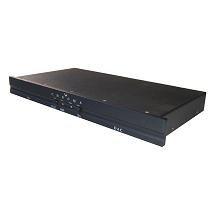
Chroma, unlike the 'big paperback'-sized Cobalt, is a 'proper' 430x50x210mm (WHD) device. Conveniently if not coincidentally, it's just the right width to rest atop a Marantz CD-63SE, and low and sleek enough to be unobtrusive. The restricted depth, however, limits the number of components which might rest on top of it, in case your stacking plans differ from mine. What this larger-than-Cobalt case means is that there's space for a much bigger power supply and an improved circuit layout. And that alone is enough to justify the extra yard-and-a-half. Chroma is to Cobalt, in a number of ways, what a Marantz SE is to a non-SE model: better power supply, better chassis, sane price increase.
Two power supplies, one for the analogue section and one for the digital, reside to the left of the case, both capped with layers of vibration-deadening material. Indeed, it's stacked so thickly that the cover makes contact with it when screwed into place, adding to the unit's rigidity and the mutual damping of both the chassis cover and transformers. In addition to improving on the Cobalt's power supply and housing, Chroma also features better jitter rejection and a 'refined analog filter'. The motherboard fills the case, and it contains - despite the price of the Chroma - selected components for the brand-conscious consumer, like Wima polypropylene capacitors throughout the analogue section and Vishay bulk-foil resistors in the current-to-voltage conversion stage. The DAC is Burr-Brown's well-respected PCM-67, the 18-bit, x8 oversampling device found in the Cobalt.
If you study the Chroma 396, you see that it is absolutely straightforward and minimalist, as are most of the DACs on the planet. There's no on/off switch - you just leave it powered up all the time if you wish to avoid its tolerable 15-minute warm-up time - and you need only to choose between coaxial and optical inputs via a push-button on the beautifully finished 8mm thick front panel. Thoughtfully, Theta has included phase inversion (in the digital domain, of course) via the second front panel press button, and two LEDs to indicate lock and power-on. That's it - basic D/A conversion with frills. (And anyone who considers phase inversion a frill needs a session with ear syringe.)
At the back, an IEC socket accepts the three-core mains cable, and phono sockets are fitted for main (analogue) output, coaxial digital input and coaxial digital output. The standard model also comes with TOSlink optical input. You'll see, too, blanked-off apertures for the optional balanced outputs available for the professional version and for a second optical digital input (either AT&T or Theta's Laserlinque). So far, so normal. Now we come to the part where par-for-the-course audiophile paranoia enters the picture. The review sample featured the third and final option: HDCD.
This is not the place to get into an HDCD-vs-non-HDCD argument, for the simple reasons that (1) it's here, (2) many companies swear by it and (3) HDCD discs are (so they say) fully compatible with non-HDCD players. Basically, you can take it or leave it, needing to address it only when you want to hear a CD which is not available without HDCD encoding, eg Neil Young's latest,
Whether or not
Continue reading about the Chroma DAC on Page 2.
What's caused the aggravation is the camp favouring the pure sonic
quality of the non-HDCD Theta Chroma over the HDCD-equipped version. The cause
of these audiophiles, reviewers, designers, etc, foaming at the mouth
is the 6dB cut which affects the output of a non-HDCD signal going
through an HDCD system. According to Pacific Microsonic spec, this is
necessary to account for the allegedly greater dynamic range of HDCD
playback vs normal CD playback, though conspiracy theorists might smell a
rodent, i.e. giving HDCD discs an unfair advantage when A/B'ing them
with non-HDCD discs of the same material.
Additional Resources
As the non-HDCD Chroma doesn't suffer this, and as it uses a
different filtering system, there's a cult of non-HDCD Chroma users
arguing that it blows away the HDCD edition .
Which it most certainly does. In spades. On the other hand, Theta has
built into the HDCD version a little feature which - provided that
neither Theta, nor its dealers, nor its distributors actually activate
it, thereby pissing off Pacific Microsonics - can be used to override
the 6dB cut. According to the redoubtable Pedro at Absolute Sounds, any
audiophile who can solder should be able to do it. More importantly,
Pedro points out that the HDCD version is outselling the non-HDCD
version 4-to-1. (How many customers are performing the tweak, I can't
say.)
It would appear, then, that the prevailing wisdom calls for buying
the HDCD Chroma 396, which you then circumcise. Now that's something you
would have to undertake making a purchase, and dealers aren't
supposed to do the mod, so you'll only be able to audition an unmodified
version in a shop. Even so, I've opted for the HDCD Chroma the
modification for the review (see sidebar). I've even heard of one canny
dealer who performed the mod and fitted a switch to bypass it...which
makes you wish the Chroma came that way. Whatever, I used it with the
Marantz CD-12 and Theta Data III transports, as well as feeding into it
the digital output of the Marantz CD-63SE. Comparisons were made with
the Marantz DA-12, Audio Alchemy DAC-In-The Box, the CD-63SE's DAC and
Theta's Pro Gen V, the latter equipped with HDCD.
So subtle were some of the differences between Chroma and Pro Gen V
that I spent as much time monitoring through headphones - the DACs fed
directly into a Stax energiser driving Omegas - as I did through the
Krell KRC-3 driving a GRAAF 5050 and the Sutherland 2000 pre-amp/power
amps, into Wilson WATT/Puppy System V. What caused the confusion wasn't
the way in which the Pro Gen V bettered its baby sister but the
similarities between the two. The modified HDCD Chroma sounded just like
a scaled down Pro Gen V, much in the way that a Sonus Faber Concertino
sounds like a baby Extrema.
In the first paragraph, I said that the Pro Gen V 'astounds me with
its transparency, speed, coherence and freedom from digitalia.' The same
words apply to the modded HDCD Chroma, but by degree, relative to what
is the norm at a far lower price point. Make no mistake: the Chroma
isn't a 'compromised' Pro Gen V. While it lacks the latter's ability to
resolve the very finest detail and the lower register power which makes
the Pro Gen V a natural with systems bearing a surfeit of wooferage, the
Chroma can emulate the V's prowess in a smaller, less-revealing system.
Played through less bass-intensive systems, the sort unlikely to
exploit the full impact of Pro Gen V-derived bass, the Chroma still
manages (with both HDCD and non-HDCD material) to deliver as much
low-end information as is required to convey
weight and rhythm. You'll find yourself, time and again, recognising the
sound of the Pro Gen V in the Chromasomes. [ANDREW: PLEASE LEAVE THE
'C' IN CHROMASOME UPPERCASE!!!!!] More impressive still is the
transparency, allowing you to hear through the performance so much so
that you'll find yourself willing even to do some A/B listing to the
cables accumulating in your spares box. This is genuine high-end
performance on the cheap, limited only in absolute terms.
For those who still harbour the fear and loathing which keeps LPs
a'spinning, the Chroma is analytical yet warm, fast yet non-aggressive.
If anything tells you categorically that you're not listening to a 4000
DAC, it's a slight lack of refinement at the frequency extremes - both
ends . And that aside, the Chroma has
enough resolving powerto all but hand you, for example, a list of the
differences between, say, a CD and a direct CD-R copy, or
gold-vs-aluminium. For my money? That makes it the best sub- 1000 DAC in
the land. And I'm keeping it as my entry-level reference.
Oh, and another thing: it's one sweet way to add HDCD to the Marantz CD-63SE from which you'd rather not be parted...
Distributed by Absolute Sounds, 58 Durham Road, London SW20 0DE. Tel
0181-947 5047. Fax 0181-879 7962. E-mail [email protected]
*Why do two ex-Buffalo Springfield members have HDCD-encoded CDs? And
Hendrix didn't play on Stills' first solo? Do I smell a plot? I think
we should be told...)
Additional Resources
STOCK VERSUS MODIFIED
Let's deal with this as succinctly as possible: the modification takes -
literally - about five minutes to perform. You simply cut one track and
link two points with a small jumper. That's it. Armed with a couple of
Chromas - stock, modified, witha nd without - I arrived at the
following:
Best Sound: HDCD Chroma the modification
Best Value: Non-HDCD Chroma
Quite simply, the non-HDCD Chroma is cleaner, sweeter sounding and
more detailed (with non-HDCD discs, of course) than the unmodified HDCD
Chroma. But perform the modification and they're so close as to be
nearly indentical. If nits need picking, then the modified HDCD Chroma
still sounds a slight touch colder and more sterile than the non-HDCD
Chroma. (Again, this is using non-HDCD discs.)
Perhaps the most telling experience of all is this: through the
modified HDCD Chroma and using the test CDs which offer the same
recordings in both HDCD and non-HDCD form, the non-HDCD recordings
the HDCD versions. Sorry, gang, but I've just joined the anti-HDCD
camp. MC, one of the first to object vocally, was absolutely right.
