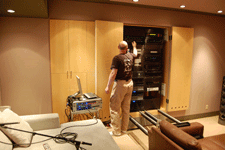
By all measures, Bob Hodas is a pretty nice guy. Known as the acoustician to many of the elite best recording studios, screening rooms and dedicated listening rooms in the world for clients ranging from Sony Music Tokyo, The Record Plant, Lucasfilm, Danny Elfman, Stevie Wonder and dozens upon dozens of other luminaries, audio/video professionals and music lovers - Bob sells a limited range of products including mostly RPG room treatments, Meyer Sound EQs and Focal speakers for some clients. But it's his professional "tuning" services where he has made his name while oddly scaring many hardened audiophiles. Additional Resources
• Read more original stories like this in our Feature News section.
• See related stories in our AV Dealers and Installers News section.
• Explore room acoustics by reading Andrew Robinson's review of GIK acoustic panels.
For enlightened clients, Bob travels the world measuring, tuning, EQ'ing, treating and bringing audio truth to rooms ranging from affordable to cost-no-object. He works a lot in Northern and Southern California but travels to any number of cities around the world to make things right in the world of audio. Bob is like a bald, vegetarian audio superman who used to mix the Doobie Brothers in the late 1970s. Are you still scared of him now?
Amazingly, in 2011 there are some who still are scared of Bob Hodas (and other top acousticians like him such as Keith Yates and Tony Grimani). The big question is - why? Here are some theories...
Theory No. 1: Fear of The Equalizer
From the very early days of audiophilia until well into the late 1980's - hardcore audiophiles attacked equalizers because they brought phase shift into the signal path. Conversely, equalizers also allow one to tailor the sound of a speaker system (and sub) to meet the specific needs of the room in ways that upgrading to the "preamp of the week" from the audiophile magazines can't deliver.
Moreover, every major recording we own has been made with EQ on every track of the mixing board, as well as mixed on speakers with room EQ. The mastering process likely adds mild levels of EQ to the product as well. Thanks to the rise in popularity of Audyessy and other room correction features in today's HDMI receivers, AV preamps and even as part of uber-high-end speaker systems like Wisdom Audio - EQ isn't the scary topic that it once was. For those of us who love music and want our systems to perform at their measured best, it's a necessary tool. Forget the hype about phase shift. Modern EQs are far better and the benefits outweigh the downside by many times.
Theory No. 2: Spending More On Equipment Gets Better Sound Than Treating Your Listening Room
The sad reality is that there are still some enthusiasts who think that you can get to audio heaven by investing solely in audiophile gear without ever fundamentally dealing with the basic acoustics of a listening room. This is simply not possible. While investing more and more into gear can get you more performance, more exotic gear and more audio jewelry - your number one audio asset is your listening room. Simple solutions can make a huge difference.
Bob Hodas absolutely hates with a passion coffee tables, as they reflect sound right in front of the listener. Simply removing one (free upgrade) from a room can clear up imaging issues. Treating the first order of reflections to the side and above a front speaker system is another affordable way to absorb audio energy that can open the width and height. Treating the corners of a high end listening room also helps a lot, as that is where bass becomes cluttered. A simple tube trap or other solution can make all the difference in the world at a cost that is a fraction of new speakers.
Theory No. 3: The Fun of Being An Audiophile Is The Journey, Not The End Game
In my days at Cello Music and Film working with Mr. Mark Levinson - there were some audiophiles who were scared of Cello much like others are scared of Hodas. They didn't want the audio journey to be over. They didn't mind losing 50 percent of their investment (pre-Audiogon era) if they were part of the audiophile club. They would spend and spend and spend; yet they couldn't use a program EQ to mildly remaster a bad sounding CD on their system.
They didn't spend on their room acoustics but they read about the latest and greatest and most esoteric audio components thinking they were some magical solutions, when in fact the solution to the question at hand is more mathematical than a lot of audio truth seekers are willing to admit. Gurus like Yeats, Grimani and Hodas can show you and get you to "flat" in your room and tune the final sound (including bass from one or more subwoofers) to your exact liking. You actually know that your audiophile investment is performing its best. Would you change out the sparkplugs in your Ferrari to see which one gave you the most horsepower or would you take your prancing horse to a Dyno and measure which one worked best for you.
In the end, knowing that your system is performing its best is something to be proud of. The studios that master and make the movies and music that you enjoy the most live up to this standard and at a certain point audiophiles and home theater enthusiasts should too. Possibly the most compelling reason to embrace room treatment and room tuning is the fact that it is the most cost effective solution money can buy today. With your room tuned - you can upgrade gear knowing that your room is solid. If you want to make changes to the tuning - that's always an option, but the increasingly expensive gear that you buy sounds even better in a well done room. Amazingly, you can get better overall performance from less expensive equipment when your room is in order.
Resources:
Bob Hodas
www.bobhodas.com
bobhodas@bobhodas.com
510.649.9254
Anthony Grimani
agrimani@pmiltd.com
Featured Audio-Video News
Are AV Retailers To Blame For Lofty High End AV Prices? -
The audio video has been in a state of flux or some time, splitting sales up between specialty dealers, big box stores, and online sellers. However, the dealers may have had more to do with this than they think.
Latest Feature News Stories
Are AV Retailers To Blame For Lofty High End AV Prices? -
The audio video has been in a state of flux or some time, splitting sales up between specialty dealers, big box stores, and online sellers. However, the dealers may have had more to do with this than they think.
How To Build and Equip Your Home Theater PC -
Home Theater PCs have become more and more popular as digital media becomes more streamlined. Andrew Robinson decided to build an HTPC from the ground up. Here's how it went.
How The DAC Got Its Groove Back -
With the advent of digital music and the easily portable nature of that format, the need for digital to analog convertors has grown and the DAC has made a journey to get to where it is today. This is that story of that journey.
The 10 Best Sounding Rooms from the New York Audiophile Show 2012 -
Jeremy R. Kipnis visited the 2012 New York Audiophile Show. He went room to room, seeing what the show had to offer. These ten rooms are what he deemed to be the best sounding systems and products presented.
How Does an OLED TV Work? -
OLED is one of the technologies that could begin the new era of HDTVs. That is all well and good, but how exactly does this new technology work and why is better than we have now?
Update On The Latest Video On Demand Technology -
Streaming technology is constantly evolving, bringing better content to your HDTVs faster in and in higher volumes. Adrienne Maxwell checks in on the technology to evaluate the state of the field.
Samsung Introduces Tube-Based Audio Products -
Samsung has stepped up its game in the audio realm, adding new table top audio systems, home theater systems, and soundbars. Adrienne Maxwell was in attendance at the Samsung event where the new products were announced.
Audiophilia's Future Looks Bright If Headphone Users Can Convert To Full Systems -
HomeTheaterReview.com publisher Jerry Del Colliano made a surprising discovery on Facebook that may show that their is hope for the youth of today to embrace the audiophile hobby.
Update: Kaleidescape Manages to Secure Stay of Injunction from Courts -
In yet another surprising turn, Kaleidescape has managed to secure a stay in their continuing appeal process regarding the legality and legitimacy of the company's media servers.
Kaleidescape Denied Stay In Court Appeal -
Kaleidescape was just dealt a huge blow by the California courts in their continued battle over the company's DVD media server systems. This time the news may not only be bad for the company, but the dealers and consumers as well.


Comment on this article
Great article. Myself, those mentioned and other acousticians certainly sympathize with the lack of awareness regarding acoustics in the audiophile arena. I hope your article opens eyes and ears for many searching to optimize their listening experience and equipment investment. I would like to add a hierarchy for achieving audio nirvana:
1. Set up
2. Calibration
3. Acoustics
4. Equipment
You can make decent equipment sound good in a good environment, but you can not make excellent equipment sound good in a poor one. It seems that many audiophiles battle over #4, while #1, 2 and 3 are missing basic performance values, hindering the electronics of their full potential.
Insightful stuff. I believe you've left out one important aspect though - the boast factor. Fear of wasting money in other audiophile's eyes - room treatments are mostly unknown, unbranded and sometimes almost invisible. So others won't know how much you've spent. The ability to impress friends is a big part of audio psychology and room treatments do not have the wow factor of huge heatsinks or bright shiny transformers with glowing valves.
A slight disagreement with Mr. Dudley. When discerning people walk in to my room, they go "Wow!" even when no music is playing. The acoustic space can be felt and heard and is amazing.
Secondly, it is often the amount of money spent on a component that is the boast factor. If that is the case for a particular audiophile, they can have their room done by one of the "complete makeover guys" such as Norm Varney at AVRS, and spend $40K on it.
Yes, this is an unsolicited plug for Norm. His work is amazing. His name belongs right up there with the others mentioned.
I appreciate the point of the piece and agree that proper set-up and room-tweaking is generally far more cost-effective than simply shelling out for the latest and greatest megabuck product.
But--no mention of Jim Smith, whose prowess at setting up show exhibits is legendary in the industry, and who literally wrote the book on the subject?
http://getbettersound.com/
Jim also travels worldwide doing nip/tuck/tweak.
Thanks for another useful, insightful piece.
Good stuff, but here's my 2 cents.
I suspect that most who read this column would would prefer to listen to a live musical performance in a good music hall than an over reverberating high school gym. If you accept this premise; It follows that most would also want their listening room to sound more like the music hall than the gym. Yes, there are many different sounding halls. But please accept this universal “music hall” for the sake of this discussion.
Most of our customer's sound rooms fall within these two parameters: music hall vs gym. Mr. Hodas, Kieth Yates, and Norm Varney set out to move the acoustical outcome more towards the “music hall” than the gym. I give them a standing ovation for their efforts.
High fidelity audio 'playback' product produces linear frequency response, low noise, and maintains phase. I also give these manufactures a 'standing-O' for their efforts. But the insertion of electronic manipulation, as Audyessy in the path of their 'playback' product, changes the output of their audio signal; that by definition is distortion.
The passive acoustical treatment and setup engaged by folks as Norm Varney's is a better option. Richard Hardesty, the AudioPerfectionist.com, once presented the issue as follows. ( I am paraphrasing from memory). The use of an equalizer in 'playback' is much as changing the tuning of a piano to overcome the bad acoustics of a high school gym. The better solution is to move the performance to a better hall or improve the acoustics of the gym.
Indeed, the new generation of electronic 'playback' equalization has improved. But its use is still a band-aid to be avoided or limited to small doses; if you still seek high fidelity audio reproduction.
As a long term practitioner of providing complex 'room EQ' in professional settings (I did the Grammy's for 7 years, the Oscars for 6 years, and about 400 other high-profile events, and developed Apogee sound's CORREQT system tuning method), I offer this:
When room resonance is correctly identified with a high-resolution spectrum analyzer (usually an FFT), and inverse EQ is applied that correctly counteracts the room resonance, the measurable phase response ALWAYS improves. While IIR EQ filters (those are the usual ones - as opposed to FIRs) will exhibit phase shift in proportion to the amplitude of boost or cut they are adjusted to, if they are properly adjusted to correct an acoustical problem in a room, the net result will be an improvement in phase response. If audiophiles were able to actually view the results of EQ (and numerous other factors) on legitimate test equipment (i.e. Hewlett Packard, Bruel & Kjaer, etc.), 90% of the mythology that drives most of the business models would evaporate rapidly. Many professional sound engineers who work in recording and/or live sound realize, quite clearly, that high-end home audio is far more about fashion than engineering. BTW, I have a rare pair of $20,000 two meter speaker cables available...to anyone who needs them :). They're made of a revolutionary material I've cleverly named Cu. Life changing - trust me!
Post a Comment
You are encouraged to post your comments using Facebook on HomeTheaterReview.com. Simply sign in to your Facebook account below and post away.