
 Update:
Creative Home Theater has informed HomeTheaterReview.com that they haven't gone out of business as was reported earlier. They claim that they are hiring new staff and working towards a new direction in the high end home theater market in Las Vegas.
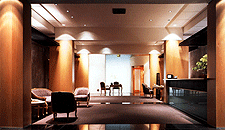
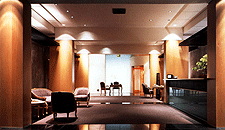
Despite eye witness reports to the contrary, Creative Home Theater is not going out of business. Creative was opened during Las Vegas' seemingly unending boom in the early 2000s, complete with some of the largest single-store orders for products like Krell, Runco, Crestron and Mark Levinson. The physical store ended up with 11,000 square feet of finished showroom space in what once was the Lamborghini showroom for Las Vegas. When completed, the store had 11 demo rooms, including a $1,300,000 reference theater built around CAT speakers, as well as no less than three Theo Kalamarakis-themed theaters. There was a full kitchen for catering and entertaining, complete with Wolf and Sub Zero appliances, granite countertops and fancy custom cabinets. Crestron keypads pumped Kaleidescape into most rooms. Custom furniture and stadium seating were found everywhere, as was full lighting control and nearly every other home theater goodie known to man seven years ago. As of just recently, that showroom is padlocked.
"Build it and they will come" is a flawed concept in high-end audio/video. The sheer cost of flooring and updating gear is nearly always too expensive to make a profit long-term. The cost of the build-out of the property, paired with the labor and overhead, requires sales numbers that are not often attainable in a good economy, let alone one that is doing its best impression of the Great Depression. Successful stores with large high-end showrooms like Definitive Audio in Belleview, Washington also come with diversified business models that include commercial installation, custom installation, marine and aviation departments, as well as retail showrooms. Build a diversified business model with clients and relationships and the profits will come. Build a showroom thinking that consumers will beat your door down and prepare to liquidate your equipment on Audiogon sooner or later.
Historically, big "build it and they will come" stores have not been successful. I watched the almighty Christopher Hansen Ltd. in Beverly Hills fail when I was in music school. Chris' store on Robertson Boulevard didn't have the sex appeal of his Beverly Hills palace, but it had an exclusive on each and every top audio line in Los Angeles, including Cello, Krell, Wilson, Goldmund and beyond - and consumers bought gear like never before. When the store moved into a KAA-designed showroom that was more home theater-centric and had architectural accoutrements that made the Peninsula Hotel look like they skimped on their design budget, people didn't flood in the front doors. When the sales staff dwindled and the marketing budget went to pay for overhead, consumer demand slipped. In 1994, the store closed only four years after opening what is still possibly the grandest audio salon in history.
The story of Christopher Hansen Ltd. isn't the only one of its kind. SoundEx in suburban Philadelphia was another juggernaut of a retail store, complete with every high-end brand one could ever hope to own, all under one somewhat low-rent roof in a location near the Pennsylvania Turnpike, with easy access for consumers from New York, Delaware and New Jersey to get deep discounts on tax-free audiophile products. For decades, SoundEx was a consistent advertiser both locally and nationally in the audiophile print magazines. They had a full sales staff, loaded with top-producing people making well north of $100,000 per year in commissions, all from being run from a flimsy, dumpy showroom loaded with gear and not properly acoustically treated. Their problems came close to a decade after the Hansen debacle, when SoundEx decided to open a 26-room, two-story Mecca for high-end audio, complete with every speaker product, electronics and cable from the likes of Wilson, B&W, Dynaudio, Audio Research, Transparent and many, many others. Every room was tuned. They had thick studio doors. They had fancy equipment racks and every audiophile goodie you could hope for, but the overhead quickly overwhelmed the business. Gone was the marketing. Video was an afterthought at a time when $10,000 42-inch HDTVs were what brought wealthy people in the door. The fact was that people went to SoundEx for price, not for a Tiffany's experience. The extra overhead didn't sell any more product and the need to pay for the overhead was what killed the business by not allowing for the creation of new customers, even if the model was to sell on price.
With brick and mortar stores failing in nearly every city in America, not just Detroit and Las Vegas, the need for a good demo for most consumers is still eminent. High-end audiophile and home theater equipment is increasingly expensive and the wrong investment can blow up in a consumer's face. The question is: if you use your local dealer who is flooring that pair of $20,000 speakers that you want to buy for a demo, but then buy them out of state to save tax, are you helping yourself to anything more than a short-term savings of money? You can find nearly anything you want to buy on Audiogon.com, but if you need and or want the service and support of an in-store demo, shouldn't you have to pay a little more for that? At the same time, arrogant audiophile stores that make demos hard to come by or treat you like Julia Roberts shopping on Rodeo Drive in Pretty Woman likely deserve to go out of business. I get far too many calls and emails from HomeTheaterReview.com readers who are furious with their local dealer for refusing to let them see and hear the system that they intend to buy. Those stores need to go away. More forward-thinking retail and hybrid-custom locations need to consider what they can offer a consumer in terms of added value to make them want to buy products new from them, as opposed to used from the Internet or out-of-state to save pennies on the dollar. Personally, I don't buy cars used, because I want a new warranty every three years or so. What if dealers offered more than the factory warranty? How about free ISF video calibration for flat HDTVs to compete with the commodity sets sold at Costco and Wal-Mart? Can the clerk at Costco improve the black levels on your new LED HDTV? I don't think so.
The specialty audio/video business needs to look at the model that Mark Ormiston and his team have built in Seattle as they go forward. While they have overhead, their diversity in terms of business model allows them the ability to weather the storm better than an all-custom install business and/or bloated retailers. Definitive is rarely the lowest on price, but they are competitive and they offer good value. They develop and ultimately pay excellent salespeople who are professionally trained on the equipment, the systems and the design of the systems. Definitive provides back-end support that is strong as well, so that the customer who spends $40,000 or $400,000 on an AV system is always taken care of, upgraded when needed and remains loyal to the store. Definitive also hosts and promotes a technology expo that brings upwards of 2,000 local consumers in for a regional CES (if you will) tradeshow for consumers that is packed with Starbucks, Boeing, Amazon and Microsoft geeky execs looking to spend some of their deep-six-figure paychecks on new AV gear.
In the end, consumers need to support those stores that help promote and develop the high end of audio/video. Saving $29 on a Pioneer receiver isn't worth it when your local dealer is there to help you. At the same time, the dealers need to offer consumers specific value that competes with the big box dealers who only sell commodity products based often only on price. In the end, the cliché of building a destination location retailer is a proven failed concept. This is a new economy and the "new normal" states that an AV retailer is going to need to be able to compete favorably with big box stores, out-of-state scoundrels and the almighty Internet, all while creating new clients and consumer demand that rings the phone and gets people booking appointments in ways that didn't happen at Hansen's, SoundEx or Creative Home Theatre.
